

We tend to view brain aging as a one-way street. Once the memory starts slipping and the mental cobwebs form, the assumption is that you are simply trying to slow an inevitable decline. But the clinical data tells an entirely different story. If you look at the evidence, dropping a few bucks on a basic ultrasound device like the US 1000 is one of the cheapest, lowest-risk bets you can make for your cognitive health.
You do not need invasive surgery or highly experimental pharmaceuticals to wake up an aging brain. You just need the right kind of physical pressure.
“To our surprise, LTP induction was rescued... not only restoring LTP, but also ameliorating the spatial learning deficits of the aged mice.”
What’s the Big Idea?
I first stumbled onto this concept about a year ago, tracking the biological hacking work of a guy named Sterling Cooley. I picked up a simple ultrasound device and started a nightly routine: a cold dab of conductive gel on the plastic wand, pressed firmly against my right temple for exactly five minutes before bed. I was flying blind. If I were smart, I would have quantified my baseline memory metrics, but I didn’t, so you will have to settle for my subjective experience. The effects hit immediately. Every single night, my head fills with incredibly vivid, sprawling dreams, and during the day, my working recall just feels sharper.
This isn't my first rodeo with ultrasound's biological effects either—I previously wrote about how ultrasound can help the heart eject damaged mitochondria, showing that acoustic waves can trigger profound cellular cleanup operations.
Now, a team of researchers from the University of Queensland has provided the biological receipts for this kind of tinkering. They took a population of senescent mice—the biological equivalent of 80-year-old humans—and exposed their brains to low-intensity scanning ultrasound.
Usually, when scientists treat brains with ultrasound, they inject tiny microbubbles into the bloodstream first. The sound waves hit the bubbles, causing them to rapid-fire expand and contract, which wedges open the blood-brain barrier to clear out neural gunk. This time, however, researchers ran a control group with just the raw ultrasound waves. The naked ultrasound actually outperformed the microbubble therapy. The simple mechanical pressure of the sound waves physically stimulated the aged brain tissue. It slashed away the rigid extracellular matrix that stiffens around older cells, sparked a 13-fold increase in new neurons in the hippocampus, and completely restored long-term potentiation. The elderly mice started passing spatial learning tests they previously bombed.
💡 In Plain English
As you age, the environment around your brain cells stiffens into rigid scaffolding like dry, compacted dirt, making it nearly impossible for new neural roots to easily branch out. Surprisingly, researchers found that skipping standard microbubble injections and relying solely on naked sound waves acts like a deep-tissue acoustic massage that vibrates this hardened earth loose. This bare-bones method actually out-performed the advanced treatments, revealing that simple physical pressure works better than complex therapies at freeing an older brain to successfully rewire itself.
Why It Matters and What You Can Do
Your brain gets physically stiff as you age. The scaffolding around your cells rigidifies, making it almost impossible for neurons to form new connections—a process scientists call long-term potentiation. That stiffness is why learning a new language or recalling a name gets harder every decade. Sound waves act like a deep tissue massage for your neural architecture, shaking the scaffolding loose so the brain can physically adapt and build networks again.
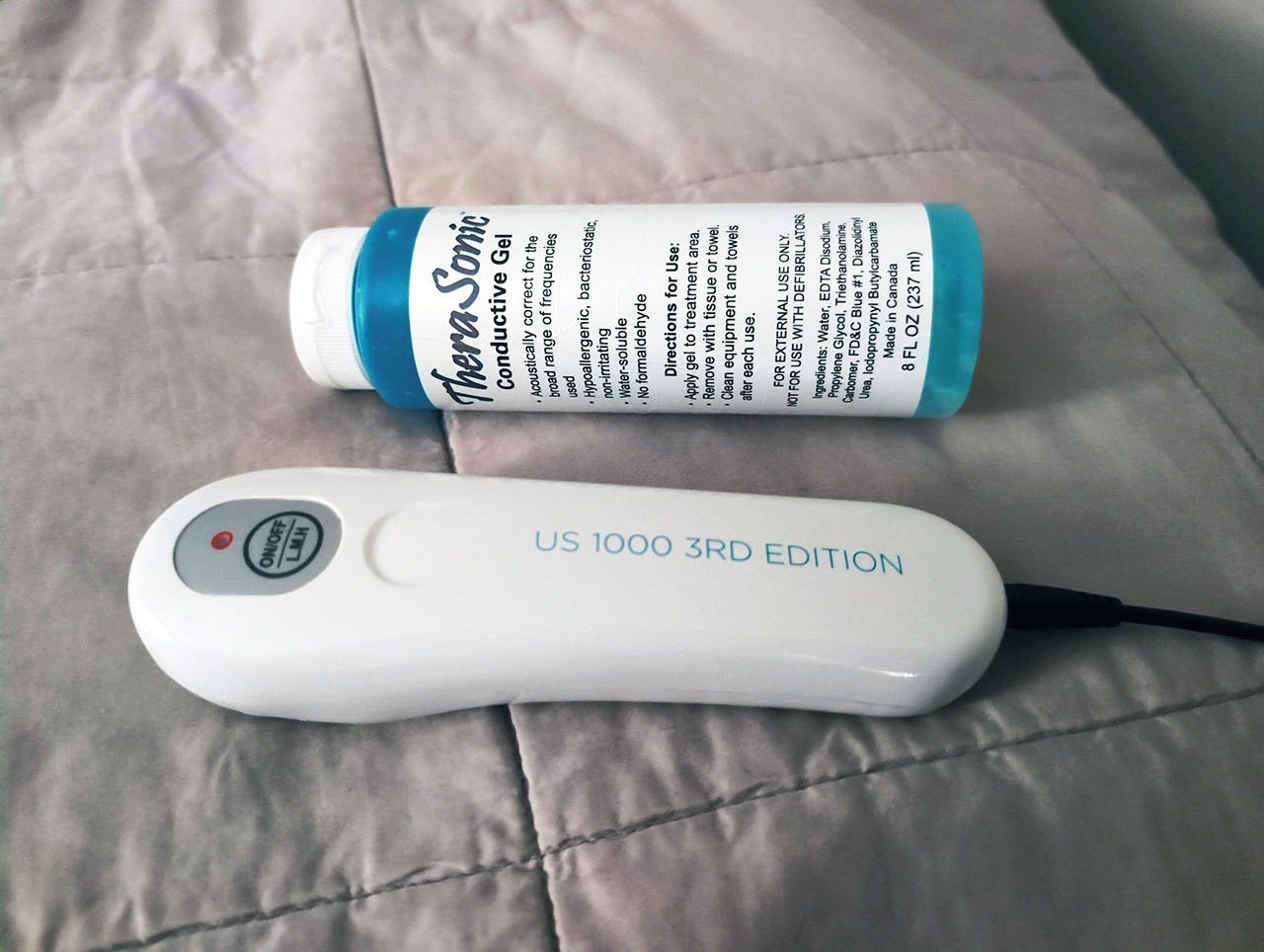
If you are going to experiment with acoustic stimulation at home, keep the protocol focused:
Get a reliable starter unit. You do not need clinical-grade hardware to produce a biological effect. A standard, low-intensity unit works well.
Use the gel. Sound waves travel exceptionally poorly through air. Without a thick layer of transmission gel between the wand and your skin, the energy just bounces off your head entirely.
Target the temples. The skull is relatively thin around the temporal region, giving the acoustic waves a direct, low-resistance path into the brain. Keep the exposure brief—around five minutes per side is plenty.
Track your baseline. Measure your sleep quality, dream recall, and daily working memory before you begin. Test it so you do not have to rely entirely on a subjective sense of improvement.
What’s Next on the Horizon?
Researchers are trying to pin down the exact sequence of events that translates a pressure wave into the growth of a neuron. The current evidence points heavily toward astrocytes. These star-shaped cells act as the brain’s caretakers, and they are highly sensitive to physical pressure. Tap an astrocyte with an acoustic wave, and it opens up specific ion channels, flooding the surrounding area with raw glutamate. That chemical bath forces nearby neurons to fire and wire together.
The exact dosage of sound is still a moving target. The mice in this study hit their peak spatial learning improvements after six weekly sessions. Figuring out the optimal frequency, duration, and placement for the human brain represents the next hurdle for clinical application. We also need to understand if the cognitive effects fade over time when the acoustic treatments stop, or if the brain fundamentally resets its baseline operating age.
Safety, Ethics, and Caveats
Mouse brains are small, perfectly smooth, and encased in very thin bone. Human brains are massive, packed with thick, irregular folds of cortical tissue, and wrapped in a dense, uneven skull. What easily penetrates a tiny rodent head behaves entirely differently when trying to navigate human bone density and vascular structures.
Low-intensity ultrasound does not produce the dangerous thermal loads seen in surgical tissue-ablation models. The study recorded less than a one-degree Celsius temperature shift at the skull, far below the threshold for cell damage. Still, blasting raw acoustic energy into your central nervous system carries inherent unknowns. We lack decadal data on regular transcranial ultrasound exposure in healthy humans.
One last thing
I still fire up the wand before bed. The sheer intensity of the dreams alone is worth holding a gooey plastic stick to my head for five minutes. We spend our lives accepting that our minds will inevitably dull over the decades, but the brain is clearly still listening. You just have to know how to push its buttons.