

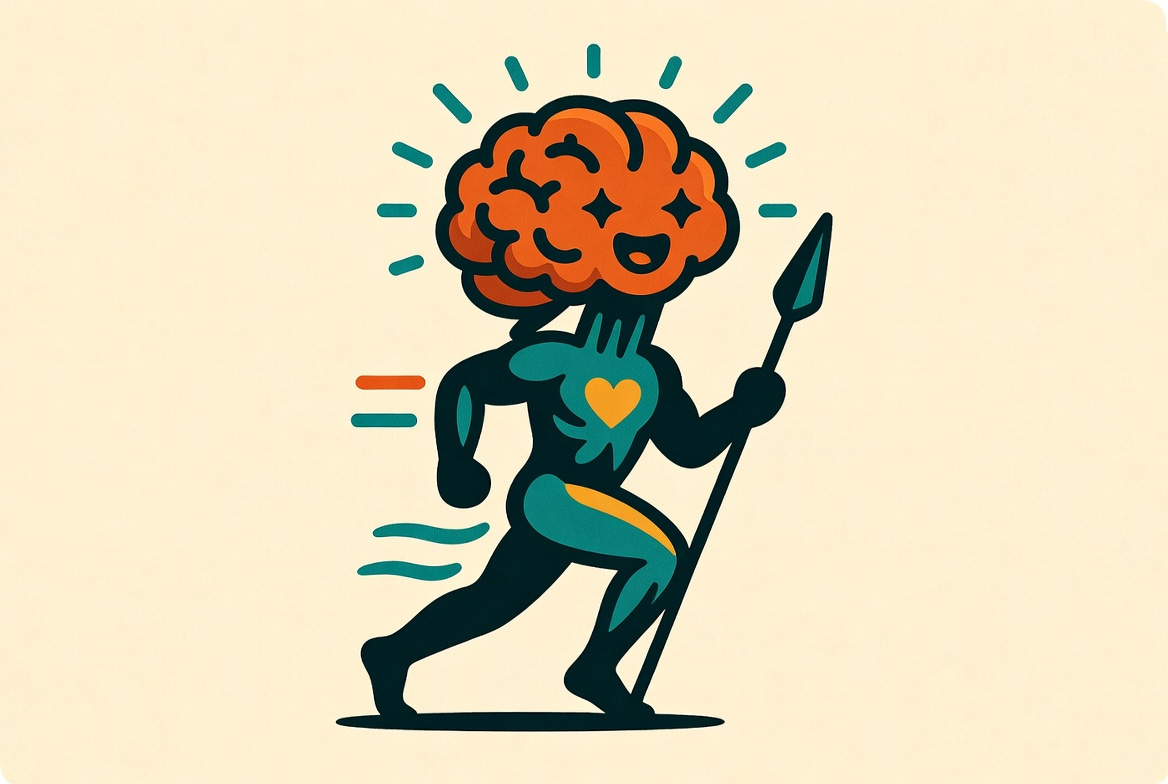
Ever notice how a long run or a tough workout leaves your head clearer, your mood steadier, your decisions sharper? I used to think I was just a sprint guy—short, violent efforts suited my build—but lately I’ve been grinding steady-state cardio in CrossFit, and honestly, the mental upgrade has been ridiculous. Calmer, focused, almost eerily productive. Sauna probably helps too, but the signal is loud: move more, think better. Turns out evolution hardwired that connection.
“In our evolutionary history, physical activity and cognitive demands were inextricably linked — selection therefore favored brains that got better when the body was working hard.”
What’s the Big Idea
The Adaptive Capacity Model (ACM) is a new evolutionary neuroscience framework that finally ties together why exercise feels like mental rocket fuel.
Our ancestors didn’t jog for fun or lift to look good on the savanna. They moved because they had to find food, escape danger, and solve complex problems while doing it. Foraging, tracking, tool-making, social coordination—all while walking or running dozens of kilometers a day. That constant pairing of physical effort and cognitive demand created powerful selection pressure: brains that allocated extra energy to neuroplasticity, repair, and growth when the body was active had a massive survival edge.
The result? We evolved an “adaptive ”capacity”—surplus energetic and neural resources that get switched on by movement. Exercise today flips that same ancient switch. It ramps up BDNF, hippocampal neurogenesis, cerebral blood flow, and anti-inflammatory signaling, but the model says these aren’t random bonuses. They’re the deliberate payoff our lineage selected for when movement and thinking were coupled.
In short: your brain expects to be paid in upgrades every time you make the body work. When you don’t, it quietly down-regulates those systems. Sedentary life is the evolutionary mismatch.
Why It Matters—And What You Can Actually Do About It
This isn’t another “exercise is good for you” paper. It’s a “we’re literally devolving our cognitive reserve by sitting on couches” paper.
Modern life decoupled the two things evolution always paired: moving and thinking. The result shows up in Alzheimer’s risk, earlier cognitive decline, and the foggy, anxious feeling so many of us accept as normal aging.
The ACM predicts the biggest brain benefits come when exercise and cognitive challenge happen together—exactly like our ancestors experienced. That’s why a walk while learning a language, rucking with a podcast, or even just doing Brazilian jiu-jitsu (high cardio + constant problem-solving) feels subjectively different than mindless treadmill time.
Practical moves that respect the model:
Pair movement with learning—language apps on walks, strategy podcasts while rowing, chess problems between sets. The combined signal is stronger than either alone.
Prioritize longer efforts—The model highlights endurance activity because that’s what ancestral foraging demanded. 45–90 minutes of zone-2 cardio several times a week appears to be the sweet spot for BDNF and hippocampal volume.
Add complex motor challenges—dance, climbing, martial arts, trail running > treadmill. The brain has to navigate space, plan sequences, adjust balance—again, mimicking ancestral demands.
Don’t neglect strength and power—while the paper focuses on aerobic, explosive efforts still trigger massive neuroendocrine responses. I’m keeping my sprints; just adding the longer stuff on top.
I fought cardio for years because “I’m not built for it.” The model (and my own experience now) says that resistance is exactly why I need it most—my adaptive capacity was lying dormant.
What’s Next on the Horizon
The authors openly call for combined interventions: aerobic exercise + cognitive training delivered together. Early animal work and a few human pilots already show bigger gains in executive function than either modality alone.
We’re also likely to see “evolutionary-matched” protocols—virtual-reality foraging games paired with cycling, or outdoor navigation challenges. The ACM even suggests timing matters: morning movement when cortisol is high may amplify the signal more than evening sessions.
Big unanswered question: can we reactivate adaptive capacity after decades of sedentary living? The model says yes, but the dose and type may need to be higher to overcome years of down-regulation. That lines up with the “exercise deficit disorder” idea in kids and the remarkable reversals we sometimes see in older adults who finally start training seriously.
Safety, Ethics, and Caveats
This is still a model, not proven fact. Most evidence is correlational or from separate exercise-only or cognitive-only studies. We need the head-to-head trials combining physical and cognitive stress to confirm the synergy prediction.
Individual variation is huge. Some people get massive mood and clarity boosts from exercise, others far less—genetics, early-life activity, microbiome, sleep all play in. The model doesn’t claim one-size-fits-all; it gives a framework for why responses differ.
Also worth noting: overdoing pure physical stress without recovery can backfire (cortisol overload, inflammation). The ancestral pattern was frequent moderate-to-hard efforts followed by rest and food, not chronic daily grinding.
One Last Thing
Your brain isn’t a separate organ that tolerates exercise — it’s a greedy opportunist that evolved to exploit movement for upgrades.
Stop treating workouts as something you do for your body and start treating them as the primary maintenance protocol for your mind.
Our hunter-gatherer ancestors didn’t need motivational quotes. They moved or they died—and their brains got brilliant as a side effect.
We can have the side effect without the dying part.
Just move. Preferably while thinking hard about something.
Explore the Full Study
Adaptive Capacity: An Evolutionary Neuroscience Model Linking Exercise, Cognition, and Brain Health
David A. Raichlen and Gene E. Alexander
Trends in Neurosciences, Volume 40, Issue 7, July 2017, Pages 408-421
https://doi.org/10.1016/j.tins.2017.05.001