

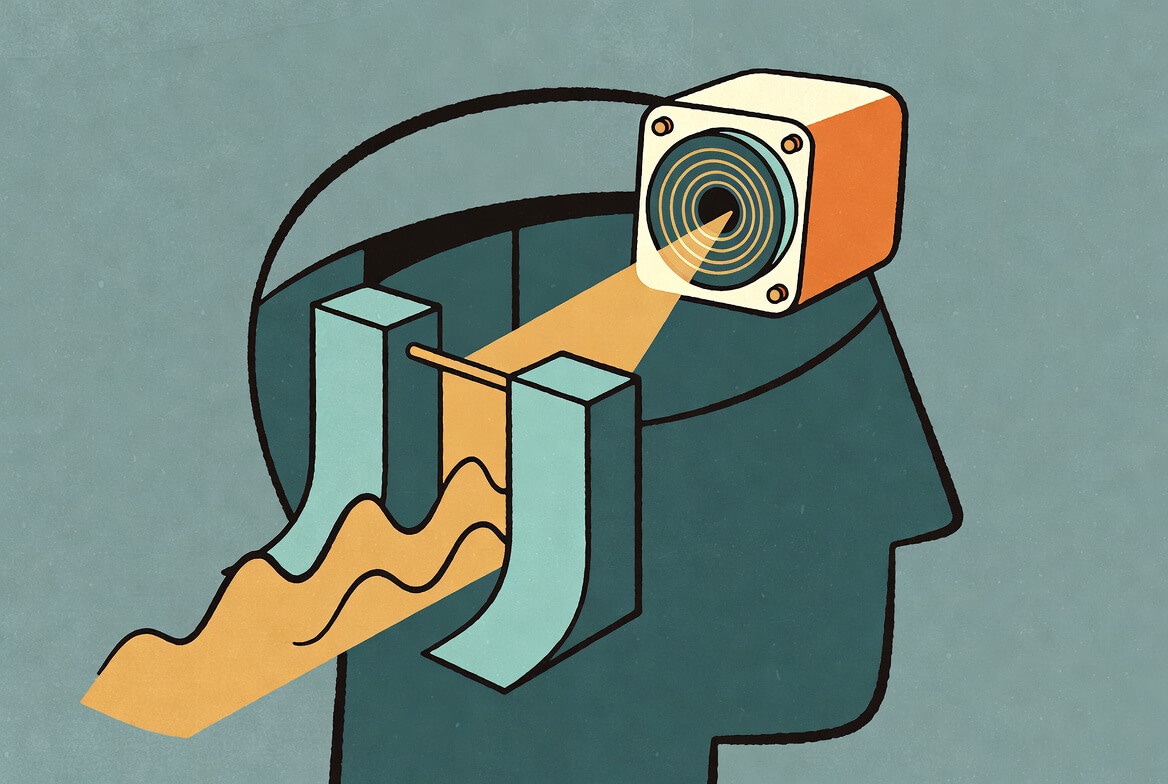
I generally prefer my science hard, fast, and reproducible. I am the guy at the party standing in the corner with arms crossed, waiting for a mountain of peer-reviewed evidence before I buy even a molehill of magic. I don’t haunt the “paranormal” section of the bookstore. I stay in the lane of neurology and physics.
But every once in a while, a paper drops that makes me put my drink down.
I stumbled across this study from the journal Cortex—not exactly a fringe conspiracy blog—and it caught me completely off guard. It tackles a subject most serious scientists won’t touch with a ten-foot pole: “Psi” (specifically, mind-matter interactions). But instead of ghost hunting, the researchers used hard-core neuroscience tools to ask a fascinating question: What if we are all psychic, but our brains have evolved to stop us from using it?
This brings to mind the mutant psychics in Total Recall—specifically Kuato, who urged Quaid to “open his mind.” It turns out, he might have been technically correct. You don’t need to open your mind; you need to shut part of it off.
“The brain may act as a psi-inhibitory filter... individuals with neurological or reversible rTMS induced frontal lesions may comprise an enriched sample for detection of this controversial phenomenon.”
What’s the Big Idea?
The study, led by Morris Freedman and his team at Baycrest Health Sciences and the University of Toronto, hinges on the “Filter Hypothesis.”
Here is the logic: If humans actually had the ability to read minds (telepathy) or move objects (psychokinesis), we should be using it constantly. It would be a dominant trait. Since we obviously aren’t tossing cars around with our thoughts, either the ability doesn’t exist, or biological evolution clamped down on it.
Why would evolution suppress a superpower? Survival. Imagine trying to hunt a mammoth or run from a tiger, but you’re constantly bombarded by the “noise” of everyone else’s thoughts or the random fluctuations of matter around you. Henri Bergson proposed this back in 1914—that the nervous system is designed to screen out reality, not reveal it, to keep us focused on staying alive.
Freedman’s team decided to test this by breaking the filter.
They recruited 108 healthy participants and hooked them up to a machine participating in rTMS (Repetitive Transcranial Magnetic Stimulation). This isn’t electroshock; it’s a powerful magnetic coil that temporarily scrambles the electrical signals in a specific part of the brain. It creates a “virtual lesion,” effectively taking that part of the brain offline for about 20 to 30 minutes.
They targeted the Left Medial Middle Frontal region. This area handles high-level executive function and, crucially, self-awareness.
Once the participants had this part of their brain dampened, they were asked to perform a “presumed” impossible task: Influence a Random Event Generator (REG). The REG produces a string of random 1s and 0s, translated visually into an arrow on a screen. The participants had one job—use their intention to make the arrow move Right or Left.
Under normal conditions, or with “Sham” (fake) stimulation, nothing happened. The arrow obeyed the laws of probability. But when the researchers knocked out the Left Frontal Lobe, the participants successfully influenced the machine. They pushed the arrow significantly to the Right, contralateral to the side of the brain they inhibited.
The filter was down, and the signal got through.
💡 In Plain English
Think of your frontal lobe as a pair of noise-canceling headphones designed to block out the universe’s background chatter so you can focus on staying alive. By temporarily shutting down this biological filter, the researchers didn't create a new superpower; they just lowered the volume on your "self" enough to let the faint signal that was already there finally come through.
Why It Matters and What You Can Do
The implications here are staggering because they shift the “psychic” debate from “does it exist?” to “where is it hiding?”
The study supports a noise-reduction model of consciousness. High self-awareness seems to act as internal noise that drowns out subtle interactions with the physical world. When rTMS dampened that self-awareness centers, the participants entered a state where their intention could theoretically couple with the machine.
You likely don’t have an rTMS coil in your garage, but the mechanism suggests less invasive ways to hack this filter.
Flow States are Key: The brain state induced by rTMS—low self-monitoring, high attention—mimics the “flow state” athletes and artists talk about. You need to lose the “I” to affect the “It.”
Meditation Over Concentration: Straining your forehead veins trying to move a pencil won’t work. The data suggests that reducing the ego (the self-awareness mediated by the frontal lobe) while maintaining focus is the sweet spot.
The “Right” Hemisphere role: Interestingly, inhibiting the Right frontal lobe didn’t work. The right hemisphere manages attention. If you knock that out, you have low self-awareness but no focus, so nothing happens. You need the combination: High Focus + Low Ego.
What’s Next on the Horizon
This research opens a door that materialist science usually keeps bolted shut. If reversible brain lesions allow for mind-matter interaction, we are going to see a pivot toward chemical inhibition.
The paper explicitly nods to psychedelics. Substances like psilocybin are known to reduce blood flow to the medial prefrontal cortex—the exact same “filter” region targeted in this study. We might soon see clinical trials combining micro-dosing or psychedelic therapy with random number generators to see if the effect scales up.
We can also expect studies using tDCS (transcranial direct current stimulation), which is cheaper and more accessible than magnetic stimulation, to see if we can “train” people to lower their frontal lobe inhibition on command.
Safety, Ethics, and Caveats
Before we get too excited, we need to look at this data with a cold, hard stare.
First, the “psi” effects observed were “micro-PK.” We are talking about statistical deviations in a computer code, not levitating X-Wings out of a swamp.
Second, the statistical analysis required a specific “weighting” procedure. Since the rTMS effect wears off after 20 minutes, the researchers had to weigh the early trials (when the brain was still inhibited) more heavily than the later trials. This is scientifically valid—if the drug wears off, you stop testing the patient—but it adds a layer of complexity that requires replication.
Finally, inhibiting your frontal lobe isn’t a game. That part of your brain prevents you from saying inappropriate things at dinner parties and helps you plan your financial future. Turning it off to win a coin toss is a bad long-term strategy which is why evolution likely built the wall in the first place.
One Last Thing
We often assume that to do more, we need to add brain power—get smarter, think faster. This study suggests the opposite. Maybe the universe is already waiting for us, and we just need to get our own brains out of the way.
Explore the Full Study
Enhanced mind-matter interactions following rTMS induced frontal lobe inhibition