


I started microdosing tadalafil for the usual reasons you hear about in the longevity and fitness spaces—cardiac health, better pumps at the gym, and because experimenting on yourself is part of the appeal. What I didn’t expect was the breathing.
Within the first week of taking 5 mg tadalafil, my lungs felt looser on runs. Fuller. The usual burn in my chest was reduced. Oxygen exchange felt improved. It was a functional difference.
So I did what any sane person does after a weird self-experiment result: I went online. Reddit was full of threads. X, too. Guys taking 5 mg before the gym reporting deeper breathing, people going to altitude saying they felt less winded.
The pattern held across anecdotal reports. Then I found the 2016 Abdelaziz et al. study that explained it.
Key takeaways
Tadalafil is FDA-approved for pulmonary arterial hypertension (PAH) as Adcirca (40 mg once daily), dilating lung blood vessels via the NO/cGMP pathway.
A 2016 rat silicosis model (Abdelaziz et al.) reported tadalafil reduced lung inflammation (TNFα down ~38%, BALF cells down ~52%), fibrosis (TGFβ1 down ~42%), and airway hyperresponsiveness (carbachol EC50 shifted right ~6-fold).
Despite tadalafil’s 17.5-hour half-life advantage over sildenafil, its benefits for fibrotic lung diseases like silicosis or IPF remain preclinical; no human confirmatory trials exist yet.
What Does Tadalafil Do to Your Lungs?
Tadalafil’s effects in the lung span three distinct mechanisms: immediate vasodilation via PDE-5 inhibition, anti-inflammatory and antioxidant activity, and potential tissue repair pathways via VEGF.
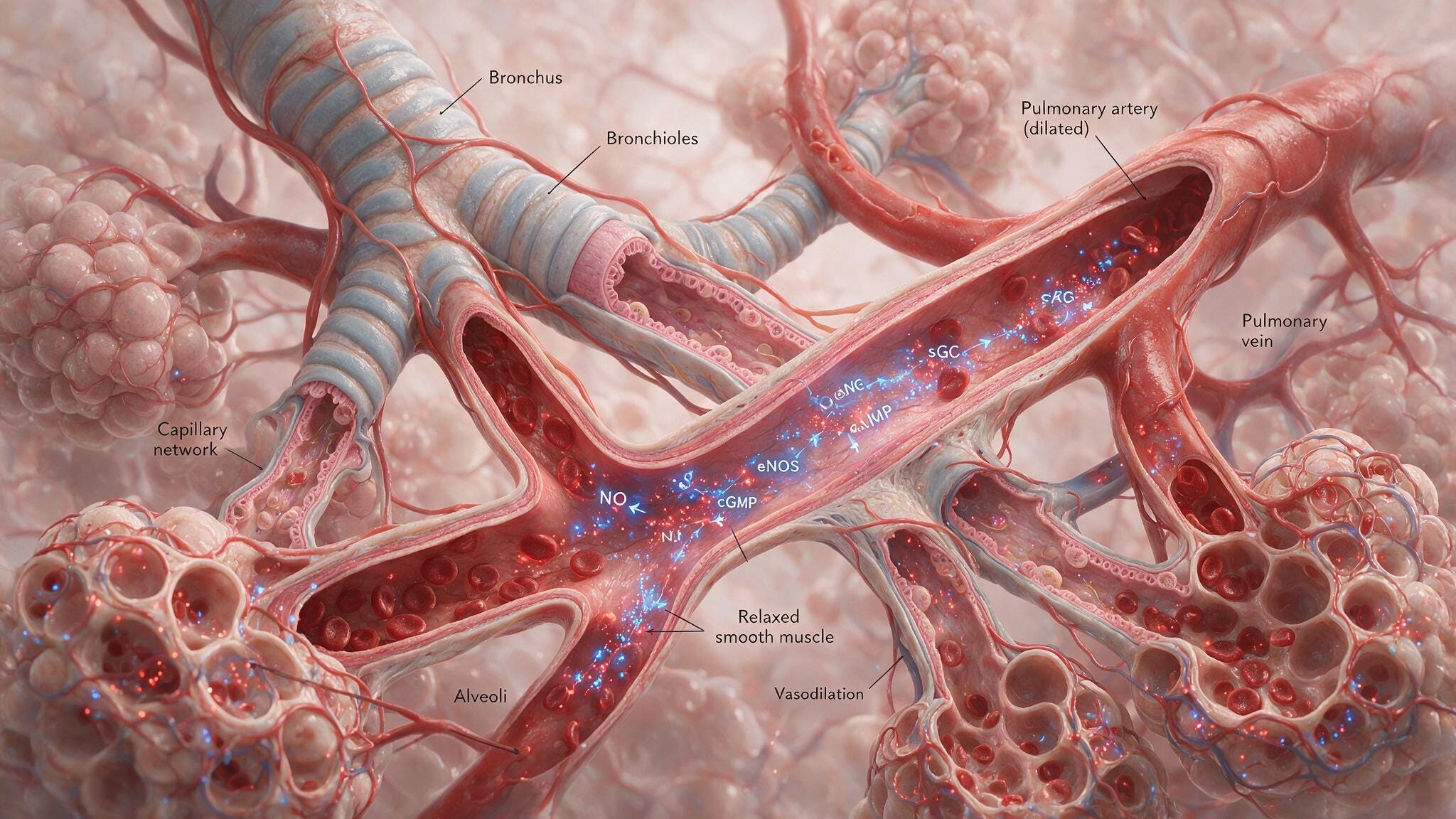
The Vasodilation Pathway: Opening Lung Blood Vessels
Tadalafil is a phosphodiesterase-5 (PDE-5) inhibitor. PDE-5 breaks down cyclic guanosine monophosphate (cGMP) in smooth muscle. Inhibit PDE-5, cGMP rises, protein kinase G activates, and the smooth muscle in pulmonary arteries relaxes. That vasodilation drops the pressure in the lungs and makes gas exchange more efficient. It’s the core mechanism behind its approved use in PAH.
Beyond Vasodilation: Anti-Inflammatory and Antioxidant Effects
But look at the rest of the data. The 2016 silicosis study measured a raft of inflammatory markers. Tumor necrosis factor alpha (TNFα) dropped by roughly 38%. Transforming growth factor beta 1 (TGFβ1), the master switch for fibrosis, fell by 42%.
Malondialdehyde (MDA), a marker of oxidative lipid damage, was reduced. Nitrite/nitrate levels, proxies for nitric oxide–related stress, fell by half.
On the protective side, superoxide dismutase (SOD) activity increased about 1.2-fold, and glutathione (GSH) content rose about 1.7-fold. The bronchoalveolar lavage fluid (BALF) cell count—how many inflammatory cells had flooded into the lungs—was cut by 52%. Serum lactate dehydrogenase (LDH), a general marker of tissue damage, plummeted 78%. The drug wasn’t just opening pipes via vasodilation; it was actively damping the fire via anti-inflammatory and antioxidant effects.
Angiogenesis and Tissue Repair: The VEGF Connection
There’s more. Through the cGMP-PKG pathway, tadalafil can promote vascular endothelial growth factor (VEGF) secretion, driving angiogenesis. Better blood supply to damaged tissue means healing in theory. The evidence is from the 2016 rat silicosis model.
Approved Use: Tadalafil for Pulmonary Arterial Hypertension
The only FDA-approved lung indication for tadalafil is pulmonary arterial hypertension, backed by the Oudiz et al. (2012) 52-week extension trial.
Clinical Trial Evidence
The human data comes from Oudiz et al. (2012), a double-blind, 52-week extension study. At 40 mg once daily (the Adcirca dose), tadalafil improved exercise capacity and hemodynamics in PAH patients. The safety profile held up over the full year.
Tadalafil vs Sildenafil for PAH
Both are PDE-5 inhibitors, but the half-lives are different. Sildenafil’s is roughly 4 hours, requiring three daily doses. Tadalafil’s is 17.5 hours—once a day. For a chronic condition, that’s a practical win. Both have solid trial data, but tadalafil wins on convenience.
Emerging Research: Tadalafil for Lung Fibrosis
The evidence for tadalafil’s broader lung potential comes from the 2016 Abdelaziz et al. preclinical study on silicosis in International Immunopharmacology, which hit every major marker of disease.
The Silicosis Study: Design and Key Findings
Abdelaziz and colleagues published the study in International Immunopharmacology in 2016. The researchers used 40 adult male Sprague Dawley rats. Silicosis was induced by intranasal crystalline silica (50 mg, obtained from U.S. Silica Company in Berkeley Springs, West Virginia). The rats then received daily oral tadalafil (1 mg/kg) or halofuginone hydrobromide (0.2 mg/kg, a standard anti-fibrotic reference drug) for 8 weeks.
The results spanned markers of lung damage measured in the study.
Lung/body weight index dropped by about 25%.
BALF total cell count down 52%.
Serum LDH down 78%.
Lung total protein down 22%.
Lung MDA down about 1.2-fold.
Lung GSH and SOD restored (1.7-fold and 1.2-fold increases).
TNFα down 38%.
TGFβ1 down 42%.
Nitrite/nitrate down 50%.
Hydroxyproline (collagen marker) down about 1.3-fold.
Collagen content down about 1.2-fold.
Tadalafil performed comparably to halofuginone across measured markers.
Airway Hyperresponsiveness: Why You Breathe Better
The researchers isolated tracheal rings and tested their contraction response. Silica made the airways hyper-responsive. The EC50 for carbachol shifted about 18-fold to the left, meaning they contracted far too easily.
Tadalafil shifted the curve back to the right. EC50 for carbachol increased about 6-fold versus the silica control. For 5-HT (serotonin), it shifted about 2.5-fold. In plain English: tadalafil made the twitchy, inflamed airways less sensitive. That’s a decrease in airway reactivity.
Histopathological Improvements
The histology tells the same story. H&E and Masson’s trichrome staining showed severe granuloma formation, silicotic nodules, and fibrosis in untreated rats. Tadalafil reduced inter-alveolar septa thickness by about 68%. It reduced blood vessel wall thickness by about 54%. Immunohistochemical staining for TGFβ1 showed a 60% reduction in expression.
The tissue showed 68% reduced inter-alveolar septa thickness and 54% reduced blood vessel wall thickness.
Beyond Vasodilation: Anti-Inflammatory and Antioxidant Effects
The anti-inflammatory and antioxidant effects of tadalafil extend beyond the reduction of inflammatory markers to impact immune cell activity and oxidative balance in lung tissue.
Inflammatory Cell Infiltration
The differential counts from the BALF paint a picture. Tadalafil reduced lymphocytes by 52%, neutrophils by 39%, and eosinophils by 62%. The immune system showed 52% fewer lymphocytes, 39% fewer neutrophils, and 62% fewer eosinophils in BALF.
Oxidative Stress
Tadalafil (Cialis) reduced the damage (MDA and nitrite/nitrate) and boosted the repair system (GSH and SOD).
Tadalafil vs. Other PDE-5 Inhibitors for the Lungs
Tadalafil’s 17.5-hour half-life and preclinical anti-fibrotic profile set it apart from other PDE-5 inhibitors for lung applications.
Sildenafil: The Closest Competitor
Sildenafil has its own lung data. Yildirim et al. (2010) showed anti-fibrotic effects in bleomycin-induced fibrosis. Wang et al.
(2009) showed it reduced airway inflammation from acrolein. But tadalafil’s 17.5-hour half-life versus sildenafil’s 4-hour half-life is a differentiator. Three daily doses of sildenafil versus one daily dose of tadalafil is a practical gap.
Vardenafil and Other PDE-5 Inhibitors
Vardenafil has shown anti-allergic properties (El-Awady and Said, 2014) but is less studied for fibrosis than tadalafil. All PDE-5 inhibitors work through NO/cGMP, but the anti-fibrotic data from the silicosis model gives tadalafil a distinct edge in the repurposing conversation.
Anecdotal Reports: Improved Breathing on Low-Dose Tadalafil
Beyond the clinical and preclinical data, user reports suggest that low-dose tadalafil may improve breathing in real-world settings, particularly during exercise or at altitude.

The Online Pattern
My n=1 fits a much larger pattern seen on Reddit and X: better breathing on low-dose tadalafil, particularly during cardio or at altitude.
What the Science Can and Cannot Explain
The 2016 rat silicosis model gives us a solid mechanism: reduced airway hyperresponsiveness (6-fold EC50 shift), reduced inflammation (TNFα down 38%), reduced oxidative stress (MDA reduced). It’s an explanation supported by the Abdelaziz et al. data. But it’s not proven. Human trials for tadalafil in silicosis or IPF haven’t been done. It’s a signal, not a conclusion.
Safety, Side Effects, and Off-Label Considerations
Tadalafil is generally well-tolerated, but the hard contraindication is nitrates — the combination causes severe hypotension.
Common Side Effects and Serious Risks
Common side effects: headache, dyspepsia, back pain, myalgia, nasal congestion. The contraindication is nitrates—the combination causes severe hypotension. Rare but serious risks include priapism, sudden hearing loss, and vision loss.
Long-Term Safety Data
The 52-week PAH extension study showed a sustained safety profile. The 8-week animal study reported no adverse lung effects. The 52-week PAH trial and 8-week animal study data are reassuring for its approved and studied contexts.
Adcirca vs. Cialis
Same molecule, completely different labels. Adcirca is 40 mg once daily for PAH. Cialis is 2.5–20 mg for ED. They are not interchangeable without medical oversight. The dose difference alone is large.
The Future of Tadalafil in Respiratory Medicine
I took a drug for one reason, noticed an unexpected effect on my breathing, found people reporting the same thing, and dug into the science. The science—specifically the 2016 Abdelaziz et al. silicosis model—gives that feeling a solid mechanistic backbone. Vasodilation via PDE-5 inhibition, anti-inflammation via TNFα reduction, antioxidant restoration via GSH and SOD, direct reduction of airway hyperresponsiveness via EC50 shift. It all fits.
The gap is human trials. We need to see if this holds up in people with silicosis, IPF, or other fibrotic lung conditions. The preclinical signal from the 2016 rat study is present, but it’s not medical advice.
If your breathing feels better on tadalafil, the research suggests you’re not imagining it. But talk to a doctor about your lungs, not a self-experimenter about his weird hobby.
Frequently Asked Questions
Is long-term use of tadalafil harmful?
The longest human safety data comes from a 52-week PAH trial at 40 mg daily, which showed a sustained safety profile. Common side effects include headache, back pain, and nasal congestion, but the hard rule is never combine it with nitrates. For approved uses, the long-term data is reassuring, but off-label use lacks that same depth of evidence.
Can tadalafil cause pulmonary embolism?
There is no evidence in the available clinical or preclinical data linking tadalafil to pulmonary embolism. In fact, its approved use in pulmonary arterial hypertension is to lower pressure in lung blood vessels, not to cause clots. If you have concerns about clotting risk, that’s a conversation for your doctor.
Does tadalafil increase oxygen levels?
Tadalafil improves the efficiency of gas exchange by dilating pulmonary arteries, which can increase oxygen uptake during exercise or at altitude in some people. The mechanism is better blood flow through the lungs, not a direct boost to hemoglobin saturation. Anecdotal reports and the preclinical data on reduced airway reactivity support this effect, but it’s not a guaranteed outcome for everyone.
How does tadalafil improve breathing during exercise?
Tadalafil reduces airway hyperresponsiveness by relaxing the smooth muscle in both blood vessels and airways, making your lungs less twitchy under stress. In the rat silicosis model, it shifted the airway contraction curve back toward normal by about 6-fold. That translates to less chest tightness and a fuller, easier breath during cardio.
What’s the difference between tadalafil and sildenafil for lung health?
Both are PDE-5 inhibitors that work through the NO/cGMP pathway, but tadalafil has a 17.5-hour half-life versus sildenafil’s 4 hours. That means one daily dose versus three, which is a practical advantage for a chronic condition. Tadalafil also has preclinical anti-fibrotic data from silicosis models that sildenafil doesn’t match.
Is 5 mg tadalafil enough to improve lung function?
The approved PAH dose is 40 mg daily, but many people report breathing improvements at 5 mg, especially during exercise or at altitude. The preclinical data shows effects at doses equivalent to human doses well below 40 mg, but no human trials have tested 5 mg specifically for lung outcomes. It’s a signal, not a proven dose.