

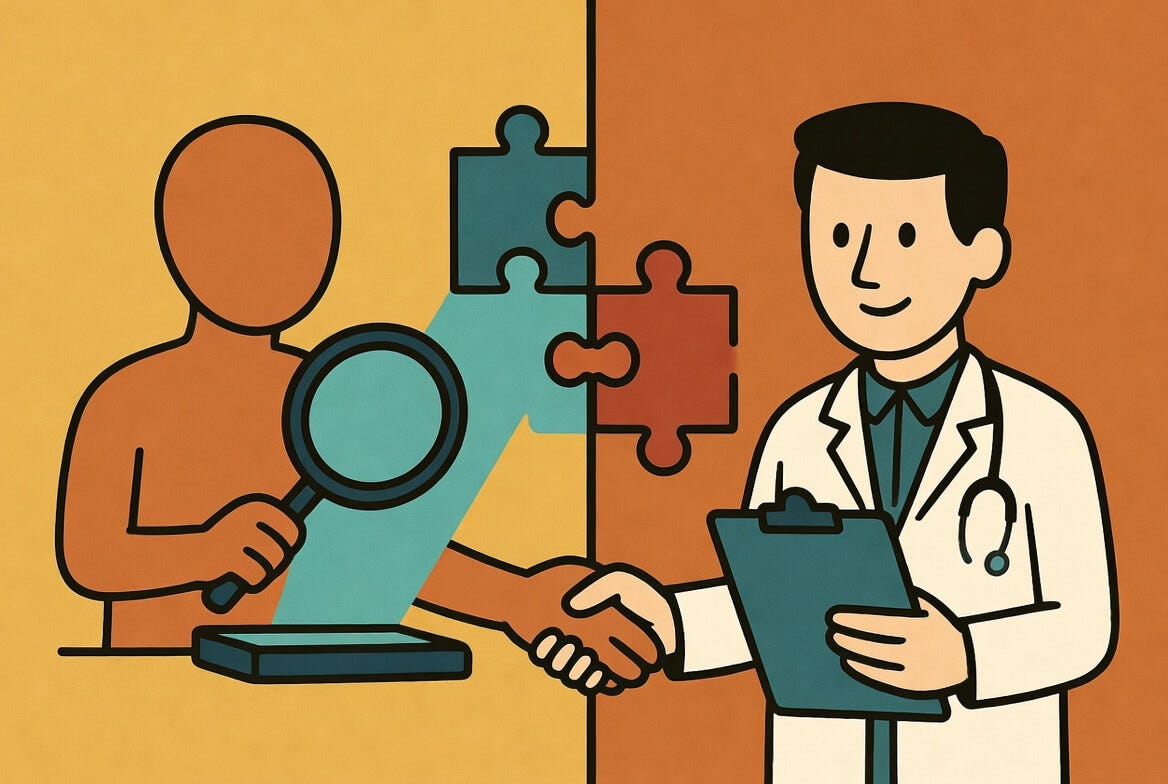
There is a specific kind of awkwardness that settles over an exam room when you have to admit where you got your information. You sit there, paper gown crinkling, and bashfully confess to the medical professional with the degree on the wall that, actually, you spent the last 48 hours doom-scrolling WebMD and Reddit threads about your symptoms. We’ve been conditioned to think this is rude. We worry the doctor is going to roll their eyes and slap us with the “don’t confuse your Google search with my medical degree” mug.
But here is the reality: You absolutely need to do your own homework.
The old model of medicine—where the doctor is the high priest of knowledge and you are the passive vessel—is dead. It’s dangerous, actually. Doctors are human. They are overworked, tired, and relying on pattern recognition that sometimes misses the nuance of your specific body.
I’ve seen this play out in the worst possible way. I recently watched a loved one go through cancer treatment, and the sheer volume of human errors they witnessed—missed interactions, forgotten history, standard-issue carelessness—would make your blood boil. That experience hammered home a brutal truth: If you aren’t fact-checking your doctor, nobody is. You do the research not because you think you know more than them, but because you need to understand the language they are speaking well enough to catch them when they slip.
A study out of the University of Leuven confirms that your instinct to “verify” isn’t just paranoia. It’s actually helping the medical process.
“More than half of the patients actually had more confidence in their doctor after falling down an internet rabbit hole. Only 5% trusted them less.”
What’s the Big Idea?
Researchers Noor Van Riel and her team decided to investigate the actual impact of “Dr. Google” on the primary care relationship. They didn’t just look at whether patients were searching (we know they are); they looked at how that searching changed the dynamic in the room. They analyzed data from nearly a thousand patients and conducted focus groups with General Practitioners (GPs) to get the unfiltered truth.
The data shreds the narrative that doctors feel threatened by informed patients. When the researchers sat down with the GPs, eight out of nine explicitly stated they didn’t see online searching as a threat. Instead, they viewed it as a tool that creates a “better mutual understanding.”
When you walk in with knowledge, you aren’t starting from zero. You skip the remedial biology lesson and get straight to the differential diagnosis. The study found that searching online generally leads to patients making appointments, rather than avoiding them. It acts as a triage nurse, validating that yes, this is worth getting checked out.
Crucially, the study found that for the vast majority of people, doing pre-visit research didn’t lead to “cyberchondria” or spiraling panic. It led to reassurance. The only people who really suffered from increased anxiety after Googling were younger patients (the 20-30 demographic) and those with pre-existing health anxiety. For everyone else, the internet didn’t break their trust in their doctor; it fortified it. The search helps you frame the problem; the doctor helps you solve it.
💡 In Plain English
Think of researching your symptoms like bringing a Pinterest board to a meeting with an architect. You aren’t trying to build the house yourself; you are simply giving the expert a clear picture of the problem so they don’t have to guess what you mean. This prep work doesn’t insult their intelligence—it skips the basic guesswork and turns the appointment into a focused strategy session.
Why It Matters and What You Can Do
The “don’t Google it” advice is outdated and condescending. The stakes are your health, or the health of someone you love. You need to be the project manager of your own care. The study highlights that the doctor-patient relationship is resilient enough to handle a little Wikipedia.
Here is how you can operationalize this findings to be a better advocate for yourself:
Own your research: Stop hiding it. Don’t say, “I heard somewhere...” Say, “I read a study on potential side effects for this medication, and I’m concerned about X.” This signals to the doctor that you are an active participant.
Fact-check in real-time: If a doctor prescribes a treatment or dismisses a symptom, take notes. Go home and verify. As my friend found out during that cancer battle, catching a mistake isn’t an act of rebellion; it’s a safety net.
Use the “Sandwich” Method: Present your findings without attacking their expertise. “I know you’re the expert here, but I read about [Condition X] and it sounds a lot like what I’m feeling. Can we rule that out?”
Distinguish between “Info” and “Review”: The study noted that while patients use the internet to prepare, they rarely use it to self-medicate without a consult. Keep that boundary. Use Google to generate questions, not to write your own prescriptions.
What’s Next on the Horizon
We are moving toward a “Shared Decision Making” model. The medical community is slowly realizing that an empowered patient—one who understands the vocabulary and the risks—adheres to treatment better.
Future tech will likely bridge this gap even further. Imagine AI tools that don’t just give you a list of terrifying diseases but actually help you organize your symptoms into a clinical summary before you walk into the office. The friction between “what I read online” and “what the doctor says” will disappear as the sources of information merge. The doctor becomes less of a gatekeeper of knowledge and more of a guide through the data.
Safety, Ethics, and Caveats
We have to look at the downsides responsibly. The study clearly pointed out that for a specific subset of people—the naturally anxious—Dr. Google is fuel for the fire. If you find yourself unable to sleep because you’re convinced a headache is a glioblastoma, the research suggests you are part of the group that is negatively affected.
There is also a quality control issue. The study notes that while doctors are open to discussing your findings, they do worry about where you got them. Bringing in a peer-reviewed abstract is helpful; bringing in a printout from a conspiracy blog about chemtrails is not. The burden is on you to filter your sources. If you bring garbage data into the consult, you aren’t advocating for yourself; you’re wasting the appointment time you paid for.
One Last Thing
Your doctor works for you. Do your research, ask hard questions, and never apologize for trying to understand what is happening inside your own body.
Explore the Full Study
The effect of Dr Google on doctor–patient encounters in primary care: a quantitative, observational, cross-sectional study
Van Riel N, Auwerx K, Debbaut P, Van Hees S, Schoenmakers B.
Read the full paper here