

Stabbing your own face with hundreds of tiny needles sounds less like a skincare routine and more like a medieval punishment. But when you look at the actual clinical outcomes, deliberately perforating your skin happens to be one of the most reliable ways to force cellular regeneration, clear up adult acne, and smooth out your complexion.
I first got interested in microneedling years ago. I had this stubborn, quiet hope that rolling a drum of tiny spikes across my skin would erase my keloid scars. I ran that human experiment on myself for a while and—unfortunately but unsurprisingly—it was a complete bust. Knowing what I know now about how raised scars react to trauma, I’m not shocked my DIY approach yielded nothing.
Despite my own failed scar crusade, I get asked constantly about microneedling and whether the benefits justify looking somewhat sunburned and bloody. They do. Especially if you are an adult suffering from acne or uneven, pitted texture, this is a conversation worth having. The mechanics behind why it works are entirely weird, heavily electrical, and vastly different from almost every other cosmetic treatment out there.
“When a medical grade, non-traumatic microneedle enters the stratum corneum and is pushed into the intercellular space, the only possible reaction is a short circuit of the endogenous electric fields.”
What’s the Big Idea?
Normally, if you cut your skin deep enough, your body throws everything into emergency mode. You bleed, you swell, an intense inflammatory response kicks in, and weeks later, your body haphazardly throws down tough, directional collagen fibers. You end up with a scar.
Dermatologists and researchers Horst Liebl and Luther C. Kloth wanted to map out exactly why microneedling breaks this rule. You take a tool covered in up to 200 tiny needles, press it 1.5 millimeters deep into the skin, and repeat. Logic says this much trauma over a concentrated area should leave you covered in scar tissue. It doesn’t. And unlike ablative cosmetic lasers that literally burn off the superficial layers of your skin to force regrowth, microneedling sidesteps the massive inflammatory cascade almost entirely.
The secret relies heavily on your body’s electrical currents. Human skin maintains a negative potential difference—essentially a natural resting battery charge—averaging around -23.4 millivolts. When a tiny, non-traumatic stainless steel needle pieces the outer layer of skin and slides into the intercellular fluid, it creates a momentary biological short circuit.
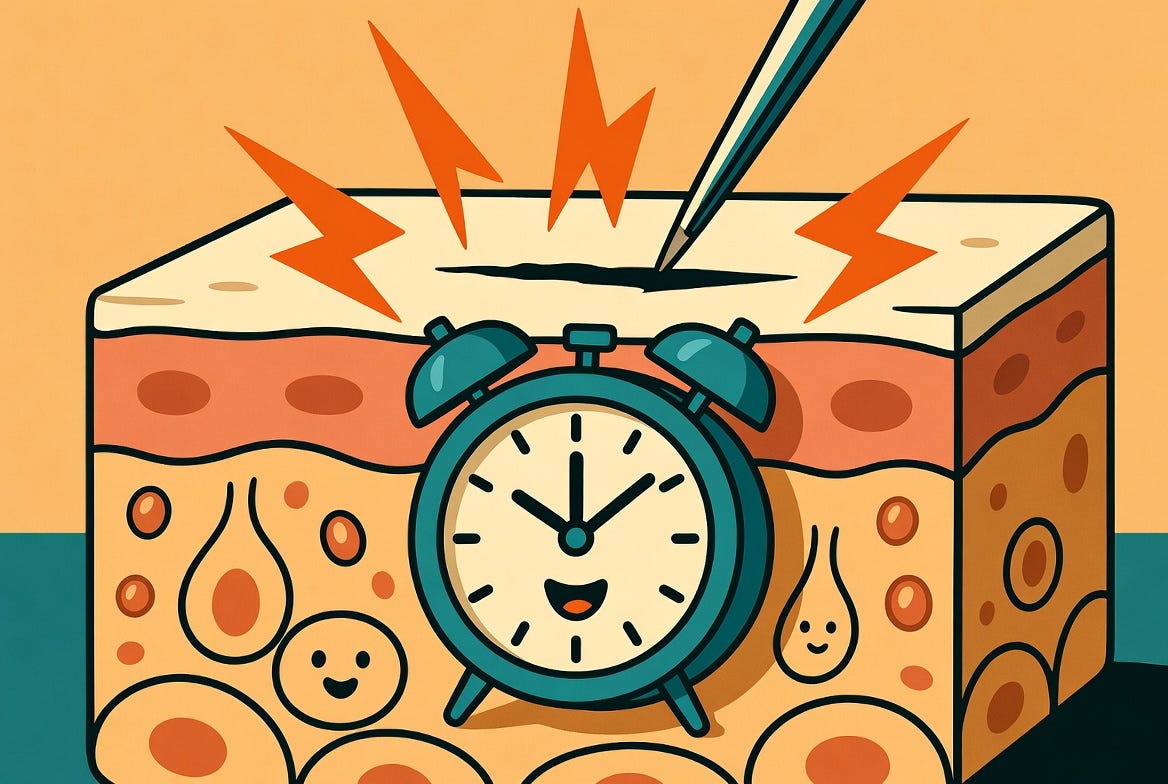
Your cells react to this sudden electrical drop immediately. To fix the disruption, microscopic cellular pumps furiously push sodium out and pull potassium in. This rapid charging and discharging process creates an electromagnetic field right around the puncture wound. That electrical shift acts like a cellular alarm clock. It directs nearby epithelial and endothelial cells to start migrating, and it actually alters gene expression to pump out growth factors.
Because the needles merely push cells aside and puncture tiny capillaries rather than tearing massive holes in the tissue, the skin repairs the micro-wounds in a completely different way. You don’t get heavy scar tissue. You get fresh, highly elastic type III collagen.
💡 In Plain English
Rather than bulldozing the skin to force regrowth like aggressive lasers do, microneedling acts like tripping a microscopic circuit breaker to safely reboot a frozen system. The tiny steel needles create a temporary biological short-circuit that serves as a cellular alarm clock, signaling your body to instantly start building highly elastic, fresh collagen. This subtle electrical hack triggers intense deep-tissue regeneration while completely bypassing the massive inflammatory emergency response that normally leaves behind messy scar tissue.
Why It Matters and What You Can Do
The clinical outcomes depend heavily on exactly what you are trying to fix. You are not just arbitrarily building collagen; you are reprogramming how your skin behaves depending on its current state.
Halting adult acne: Acne flare-ups are largely driven by androgens stimulating an overproduction of keratinocytes—dead skin cells that clump up and block your sebaceous glands. Needling down-regulates this hyper-proliferation. A few sessions can effectively clear the biological traffic jam keeping those glands blocked.
Filling in sunken scars: If you have pitted or depressed acne scars (what the literature calls hypotrophic scars), the treatment is highly responsive. The micro-wounds trigger fresh collagen that builds from the bottom up, leveling out the skin usually within three to four weeks.
The reality check on raised scars: My old keloid experiment failed for a highly documented reason. Overactive, raised scars (hypertrophic and keloid) or severe burn scars do not respond quickly to this treatment. The paper notes a failure rate around 30% for these types, and even successful cases require many months to show minor degradation. If you are dealing with thick, raised tissue, adjust your expectations dramatically.
Fading lingering redness: Lasting erythema from thermal exposure or old inflammation actually responds quite well. The needles stimulate enzymes known as matrix metalloproteinases (MMPs), which break down damaged, clumped blood vessels and trigger the growth of fresh, healthy capillaries in their place.
What’s Next on the Horizon?
The exact behavior of epidermal and dermal stem cells under repeated needling is still largely a black box. Researchers know the cells proliferate, but the granular mechanics of how those stem cell lines stay active need mapping out.
There is also a push to understand exactly why hyperpigmentation fades after treatment. The prevailing assumption points to those same MMP enzymes chewing up excess melanin or balancing out cell activity, but the exact pathway isn’t confirmed. Finally, surgeons are increasingly comparing microneedling to ablative CO2 lasers for delivering transplanted cells—like moving healthy melanocyte cells to treat vitiligo. Microneedling injures the dermal blood vessels just enough to allow access for the new cells without burning or killing the surrounding tissue, which gives it a significant edge over lasers.
Safety, Ethics, and Caveats
Doing this at home with a cheap roller wrapped in dull, bent needles is a recipe for actual scarring. The study specifies “medical grade, non-traumatic” needles with a tip radius of no more than 2 to 3 micrometers. A blunt needle tears the skin instead of parting it, triggering the exact massive inflammatory response you need to avoid.
Healing requires patience. You will experience visible redness for about 48 hours for a standard treatment. While the superficial skin layers close up within 15 minutes—making infection highly unlikely—the real magic happens deep underneath. The peak proliferation phase takes up to two months. The fresh collagen you build needs even more time to mature into the elastic, permanent type I collagen your face needs. Don’t rush it, don’t overdo the frequency, and if your skin is deeply pigmented, seek out a professional to avoid accidentally triggering further dark spots from the inflammation.
One last thing
We spend so much time putting expensive creams onto dead layers of skin, hoping they soak in. Sometimes, the most logical way to force a system to heal itself is to carefully, precisely break it.
Explore the full study
Skin Cell Proliferation Stimulated by Microneedles by Horst Liebl and Luther C. Kloth, Journal of the American College of Clinical Wound Specialists (2013).