

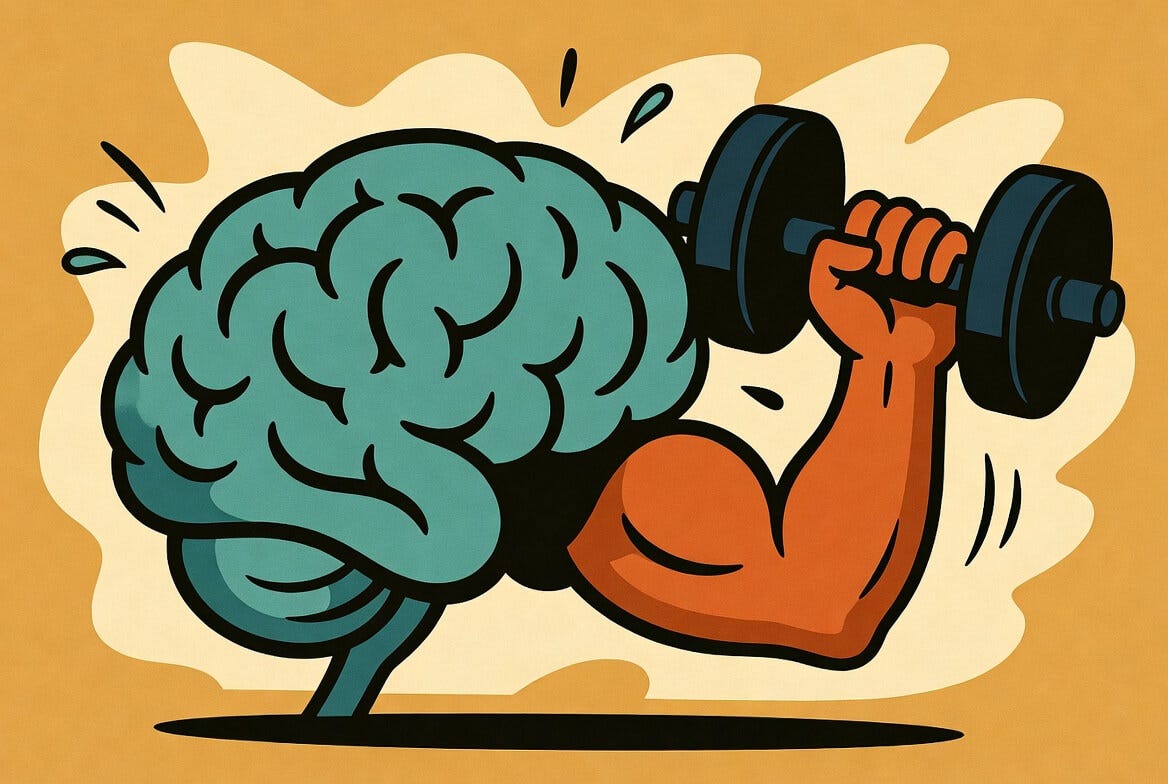
If you think strength is purely a product of tearing muscle fibers and chugging protein shakes, you’re only looking at half the equation. We tend to view strength as a physiological event—a brute measurement of contractile tissue. But before a muscle fiber twitches, a neuron fires. Strength is, at its core, an electrical signal.
And here is the glitch in the matrix: you can hack that signal without ever touching a barbell.
We often relegate “visualization” to the realm of self-help gurus and crystals, but the hard data tells a much more aggressive story. The research suggests that your brain struggles to differentiate between doing a thing and intensely imagining a thing.
Here is the zero-risk, high-upside hack you’re likely ignoring: You should be getting your reps in while you’re sitting on the couch. Even if you aren’t injured, you’re leaving gains on the table if you aren’t lifting weights in your head.
“Internal mental imagery has a greater effect on muscle strength than external mental imagery... Internal imagery results in significantly higher muscle excitation than external imagery of the same movement.”
— Slimani et al., 2016
What’s the Big Idea?
You might have accidentally stumbled onto this mechanism already. I did, though I didn’t realize it was actually training my central nervous system at the time.
A few years ago, I got serious about visualization, but not for the gym. I was trying to get better at first-person shooters like Battlefield and Call of Duty. I’d watch clips of Tyler Rake from the Extraction movies—watching him move effectively, check corners, and drop enemies with precision. But I didn’t just watch him; I imagined being him. I replayed his movements in my head as if I were holding the gun. When I booted up the game, I played significantly better. I was sharper. My reaction times were faster.
I thought I was just hyping myself up. According to a systematic review by Slimani et al., I was actually priming my neural pathways for performance.
The researchers analyzed comparative data on “Mental Imagery” (MI) and its effect on muscular strength. The results are startling. They found that mental imagery training can increase voluntary neural commands to the muscle. When you imagine a movement vividly, you aren’t just daydreaming; you are activating the same cortical networks (the primary motor cortex, basal ganglia, and cerebellum) that light up when you actually squat, bench, or climb.
But there is a catch. You can’t just watch a movie of yourself. The study draws a hard line between External Imagery (watching yourself from the outside, like a camera) and Internal Imagery (seeing through your own eyes and feeling the movement).
Internal imagery is the kingmaker. The review highlights studies showing strength gains ranging from 2.6% all the way up to 136.3% in specific contexts, largely driven by this internal, kinesthetic perspective. When you imagine the sensation of the weight, the tension in the grip, and the grind of the rep, your brain sends signals to your muscles that are surprisingly close to the real thing.
Why It Matters and What You Can Do
Most of us treat mental prep as an afterthought. We scroll Instagram between sets. We listen to podcasts while climbing. We dissociate. If you want to leverage this data to break a plateau or improve your bouldering, you need to treat your imagination like a muscle group.
The study indicates that replacing some physical volume with mental volume acts as a force multiplier. It works for healthy athletes, and it’s miraculous for injured ones effectively stopping muscle atrophy during immobilization.
Here is how to apply the protocol effectively:
Switch to First-Person Mode: Stop watching a movie of yourself. External imagery (third-person view) barely moves the needle. You need Internal Imagery. See your hands gripping the bar. Feel the chalk. Feel the gravity.
Fake the Weight: The study noted that imagining “lifting a heavy object” resulted in higher EMG (electromyography) activity than imagining a light object. If you visualize, visualize a PR. Mentally load the bar with 90% of your max. Your nervous system reacts to the perceived effort.
Keep it Brief and Frequent: You don’t need to meditate for an hour. The most effective protocols in the review were short-duration (3 to 6 weeks) with about three sessions per week.
Use it on Rest Days: Since this taxes the nervous system but not the skeletal muscle, this is the perfect way to “train” when you are physically recovering or caught in a boring meeting.
💡 In Plain English
Think of your central nervous system like a pilot in a flight simulator: watching a video of a plane flying (external imagery) teaches you very little, but sitting in the cockpit and physically feeling the controls (internal imagery) programs your reflexes for the real thing. You are effectively upgrading your body’s software so the hardware operates at peak efficiency when you finally hit the switch.
What’s Next on the Horizon
We are moving toward a hybrid training model where injury doesn’t mean obsolescence. One of the most optimistic findings in this review is about prevention of strength loss.
When you break an arm or tear an ACL, the muscle atrophies largely because the neural connection degrades. The brain “forgets” how to fire those motor units efficiently. The data shows that patients who performed mental imagery during immobilization maintained significantly more strength than those who didn’t.
For the bouldering hobbyist or the powerlifter, this changes the psychology of injury. A layoff doesn’t have to be a reset to zero. By keeping the neural pathways hot through visualization, you reduce the time it takes to get back to your previous baseline. We aren’t just looking at sports psychology anymore; we are looking at neuro-preservation.
Safety, Ethics, and Caveats
Before you cancel your gym membership to “mind-lift” in bed, please keep in mind... mental imagery is a supplement, not a replacement. The study explicitly states that the combination of mental and physical practice is superior to either alone. You still need to tear the muscle fibers to stimulate hypertrophy.
There is also a weird side effect to consider: Central Nervous System (CNS) Fatigue.
Because you are legitimately firing neural pathways, mental imagery is tiring. The review noted that high-intensity imagery drives up heart rate, blood pressure, and respiration rate. If you do an intense visualization session of hitting a 1RM deadlift right before you actually try to hit a 1RM deadlift, you might actually pre-exhaust your CNS and perform worse. Treat mental reps like real reps—they cost energy. Don’t overtrain your brain right before you need it.
One Last Thing
The next time you’re stuck in traffic or waiting for a meeting to start, don’t just zone out. visualise your next climbing route or that heavy squat. Your brain is ready to work, even if your body is stuck in a chair.
Explore the Full Study
Slimani, M., et al. (2016). Effects of Mental Imagery on Muscular Strength in Healthy and Patient Participants: A Systematic Review. Journal of Sports Science and Medicine, 15, 434-450. Link to Study