

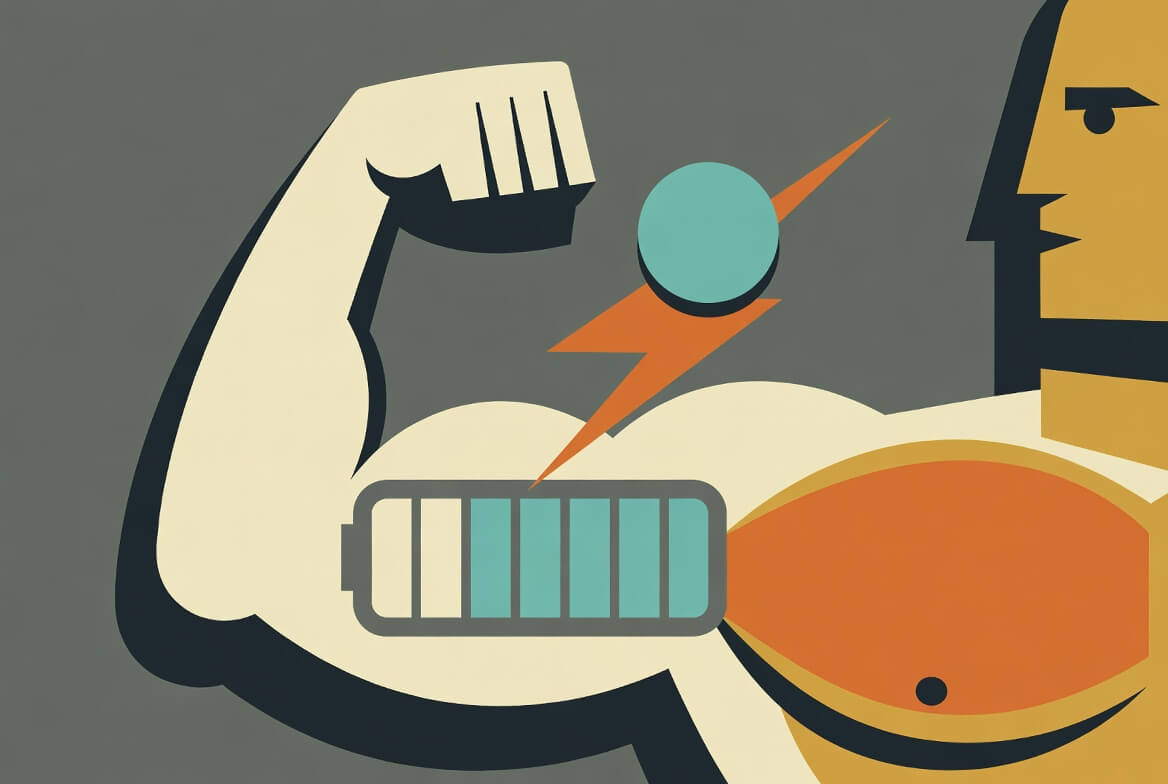
You don’t wake up one morning and decide to be weak. It happens in slow motion. First, the grocery bags feel heavier. Then, the stairs wind you. Eventually, you’re looking at a pickle jar like it’s a vault door.
We usually write this off as the inevitable slide of aging—gravity winning the long game. The scientific term is sarcopenia, but “muscle wasting” paints the clearer picture. Your body literally starts eating its own horsepower.
But new research suggests this isn’t just about wear and tear. It’s a fuel line issue. Specifically, it’s about a communication breakdown between your repair cells and your muscle fibers, and a molecule called NAD+ might be the only thing keeping the lines open.
“NAD+ pretreatment essentially gave the stem cells a megaphone, amplifying their ability to shout ‘GROW’ at the withering muscle fibers.”
What’s the Big Idea?
A research team out of Shandong University just dropped a fascinating paper on how to hack the aging process in muscles. They were looking at Mesenchymal Stromal Cells (MSCs). Think of MSCs as your body’s general contractors—they show up to injury sites and coordinate repairs.
The problem? As we get older, our general contractors get tired. They get confused. They stop showing up.
The researchers tried a new trick. They took these stem cells and “pre-conditioned” them by soaking them in Nicotinamide Adenine Dinucleotide (NAD+). If you hang around longevity circles, you know NAD+. It’s the coenzyme found in all living cells that powers metabolism.
Here is the twist: Injecting regular stem cells into “aged” mice helped a little. But injecting the NAD+-supercharged stem cells worked significantly better.
The treated mice didn’t just look better under a microscope; they performed better in the real world. They ran longer on treadmills. A crucial metric the study tracked was grip strength.
I’ve been obsessing over this metric personally. My grip strength on the rock climbing wall has dramatically improved over the past six months. It’s tough to say exactly why—I quit alcohol a year ago, I’m lifting heavier, and I’m supplementing with Nicotinamide Riboside (NR), an NAD+ precursor. It’s usually impossible to isolate the variable in your own life (n=1), but this study connects the dots. The mice on the NAD+ protocol held on longer. The chemistry supports the anecdote.
💡 In Plain English
Think of your aging stem cells like a repair crew that showed up to the job site but forgot their radios—they are present, but they can’t coordinate the fix. The NAD+ treatment acts like a high-powered transmitter, allowing these cells to blast the specific instructions your muscle fibers need to burn off fat and rebuild their internal power plants. It turns a confused, tired biological response into a precise, energetic renovation.
How It Works (The Mechanics)
The study didn’t just show that it works; it mapped out how.
When the stem cells were bathed in NAD+, they started secreting massive amounts of an enzyme called NAMPT. This is the key. NAMPT is the signal.
When this enzyme hits the muscle cells, it kicks off a domino effect:
SIRT1 Activation: It wakes up the SIRT1 protein (often called the “longevity gene”).
Mitochondrial Reboot: SIRT1 tells PGC-1α to get to work. PGC-1α is the master regulator of mitochondrial biogenesis. It essentially tells the muscle cells to build more power plants.
Fat Burning: The muscles stopped hoarding fat (which clogs up the machinery in aging muscles) and started burning it for fuel via improved fatty acid oxidation.
The result was muscles that looked younger, had better structure (less fibrosis), and generated more ATP (energy).
Why It Matters and What You Can Do
We are looking at a potential roadmap for keeping your physical independence. The study implies that keeping your NAD+ levels high doesn’t just help your metabolism; it might actually empower your body’s repair systems to do their job properly.
If you’re watching your strength plateau or decline, here is the takeaway:
Look into NAD+ Precursors: This is the big one. Direct NAD+ is hard to get into cells, but precursors are accessible. As I’ve found with my own regimen, it’s probably worth trying NR or NMN if you can afford them. I take Nicotinamide Riboside Tartrate because it hits the sweet spot between efficacy and cost, but the goal is the same: keep the fuel tank full so the repair crew can work.
Prioritize Grip and Explosive Movement: The study used grip strength as a proxy for total body decline. Test yours. If it’s slipping, your systemic health might be slipping too. Train it directly (farmers carries, dead hangs).
Manage Lipid Buildup: The study specifically noted that “older” muscles get filled with fat droplets (lipid accumulation), which ruins their function. The NAD+ treatment forced the muscles to burn this fat. You can mimic this with Zone 2 cardio and fasting, which force metabolic flexibility.
What’s Next on the Horizon
This research opens the door to “empowered” cell therapies. Instead of just injecting stem cells and hoping they survive the hostile environment of an aged body, doctors might soon “train” these cells in a bath of NAD+ (or other compounds) before they ever touch the patient.
It suggests a future where sarcopenia isn’t treated with just exercise and protein shakes, but by directly manipulating the energy signaling pathways that tell muscles to wither in the first place.
Safety, Ethics, and Caveats
Before you go bathing in NAD+, there are a few caveats to consider.
First, this was a mouse study. And not just old mice—these were mice given D-galactose to chemically induce aging. While this is a standard model, it’s not a perfect replica of the slow, natural decay of human aging. Chemical aging happens fast; human aging is a slow burn.
Second, there is a gender gap here. The study only used male mice. The authors admit this is a limitation, especially since hormonal differences (testosterone vs. estrogen) play a massive role in how muscles age and maintain mitochondria.
Finally, tinkering with growth pathways (like SIRT1 and PGC-1α is generally good for muscles, but you always want to be careful about “growth” signals if you have underlying issues. The body typically downregulates energy for a reason.
One Last Thing
Muscles are the organ of longevity. If you want to stay in the game, you have to keep them fed—not just with protein, but with the bio-electrical spark that tells them they’re still needed.
Explore the Full Study
NAD+ Enhanced Mesenchymal Stromal Cells Effect on Muscle Atrophy by Improving SIRT1-Mediated Mitochondrial Function via NAMPT (Song et al., 2025)