

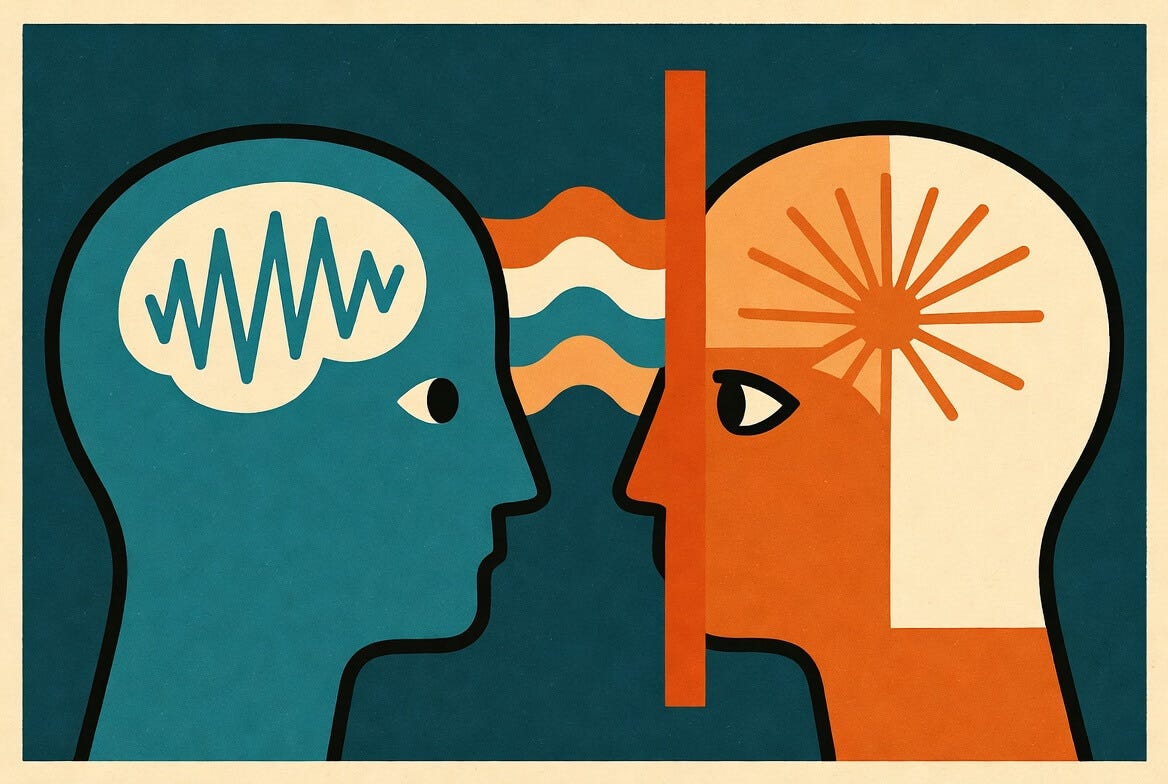
Let’s be honest about something that usually makes us feel like terrible people. When we are around someone who is deep in the throes of depression—not just having a bad week, but truly stuck in the gray—we often feel a visceral urge to back away.
I’ve noticed this in myself for years. It’s not just that I find the negativity draining; it’s that I feel physically repelled, almost like my body is trying to engage a quarantine protocol. For a long time, I chalked this up to being a fair-weather friend or just lacking patience.
But looking at the neuroscience of “emotional contagion,” that instinct to run makes a lot more sense. It turns out that my brain—and yours—is actually trying to protect itself from infection.
A 2022 review by Paz et al. in Neuroscience and Biobehavioral Reviews breaks down the mechanics of how depression spreads through social networks. The data suggests that depression behaves frighteningly like a virus. But here is the catch: we can’t just abandon our friends to save ourselves. The trick is figuring out how to stay in the room without letting their neural static become your reality.
“The probability of an individual becoming ‘discontent’ increases with the number of discontent contacts... Evidence from a study demonstrated that roommates of depressed college students became more depressed after three weeks living together.”
— Paz et al., referencing Joiner (1994) and Hill et al. (2010)
What’s the Big Idea?
We like to think our emotions are private events that happen inside the sealed container of our own skulls. The research says otherwise. We are porous. We leak emotions, and we absorb them.
The study highlights two main mechanisms that turn us into emotional sponges: Automatic Mimicry and the Mirror Neuron System (MNS).
1. Automatic Mimicry (The Copycat Effect)
This is the primitive stuff. When you look at your friend, you are constantly, unconsciously micro-mimicking their face, their posture, and their tone. If they slump, you slump. If the corners of their mouth turn down, your micro-muscles do the same.
Here is the wild part: It’s not a one-way street. According to the “facial feedback” hypothesis discussed in the paper, once your muscles mimic the expression, your brain receives a signal that says, “Oh, we’re doing ‘sad’ now,” and releases the corresponding neurochemistry. You don’t feel sad and then frown; you frown (mimicking them) and then feel sad.
2. The Mirror Neuron System (Simulation Theory)
Deep in your brain—specifically areas like the inferior frontal gyrus and the limbic system—you have “mirror neurons.” These are the hardware of empathy. When you see someone in pain, these neurons fire in a pattern that simulates that pain in your own head. It’s an evolutionary feature designed to help us understand each other and bond.
But when you hang out with a depressed person, your mirror neurons are working overtime to simulate a brain state that is chemically dysregulated. If you do this long enough, your brain starts to sync up with theirs. You aren’t just “feeling for” them; you are literally neural-synchronizing with their despair.
💡 In Plain English
Think of your mirror neurons like a Bluetooth setting that is always stuck on “discoverable.” When you interact with a depressed friend, your brain automatically “pairs” with theirs, downloading their emotional state just as your phone would sync data. You aren’t merely observing their sadness; your neural hardware is physically syncing to their signal.
Why It Matters and What You Can Do
So, we have a dilemma. If we follow our survival instinct (that “repelled” feeling), we abandon people when they need us most. If we dive in unprotected, we risk catching the bug ourselves.
Peer contagion is real. Especially if you engage in “co-rumination”—that’s scientist-speak for sitting around endlessly rehashing the same negative problems without looking for solutions. The data shows this is a super-highway for transferring depressive symptoms.
Here is how to set boundaries that function like emotional PPE (Personal Protective Equipment):
Audit Your “Empathy Type”: There is a difference between emotional empathy (feeling what they feel) and cognitive empathy (understanding what they feel). The former relies on those dangerous mirror neurons. Try to stay in “Cognitive Mode.” View their situation like a consultant, not a co-pilot.
Stop the Co-Rumination: You can listen, but put a cap on the loops. If the conversation circles the drain three times, it’s time to pivot. High degrees of “reassurance seeking” make the contagion effect worse.
Physiological Reset: Since mimicry works outside-in (body to brain), you need to physically shake it off. I’ve found that high-intensity intervention—like a scorching sauna or heavy lifting—is the only way to hard-reset my system after a heavy emotional session. You have to sweat the simulation out of your system.
The Oxygen Mask Rule: You can’t save a drowning swimmer if you’re also cramping up. Setting a boundary—like saying, “I can’t talk about this heavy stuff tonight, but let’s watch a movie”—isn’t abandonment. It’s infection control.
What’s Next on the Horizon
The paper points toward some fascinating tech that might help us fix the hardware rather than just managing the software.
Depressed individuals often have a “broken” mirror neuron system—they struggle to interpret or mirror positive emotions (like a happy face), which isolates them further. The authors discuss rTMS (Repetitive Transcranial Magnetic Stimulation), which uses magnets to stimulate these brain regions.
There’s also tDCS (Transcranial Direct Current Stimulation), a more accessible mood-modulating tech that uses low-level electrical currents. While we aren’t quite at the “zap your potential” stage for everyone, the implication is huge: if we can jumpstart the brain regions responsible for social connection and empathy, we might be able to stop the contagion at the source.
Safety, Ethics, and Caveats
Before you go diagnosing your roommate, hold on. Not everyone is equally susceptible. The review notes that your risk depends on your personality (people who see themselves as highly “interdependent” catch emotions faster) and genetics (some of us are just genetically prone to anxiety and depression).
Also, a crucial warning: Don’t confuse boundaries with cruelty. The study confirms that isolation makes depression worse. The goal isn’t to leave people alone; it’s to interact with them safely. Evolution gave us empathy to ensure survival, not to drag us all down together.
One Last Thing
Being a good friend doesn’t mean becoming a martyr to someone else’s mood disorder. Keep your distance, keep your own mirror neurons checking for positive inputs, and remember: you can be a lifeline without letting them pull you into the water.
Explore the Full Study
Contagious depression: Automatic mimicry and the mirror neuron system - A review
Authors: Paz, Lisiê Valéria et al.
Journal: Neuroscience and Biobehavioral Reviews (2022)