

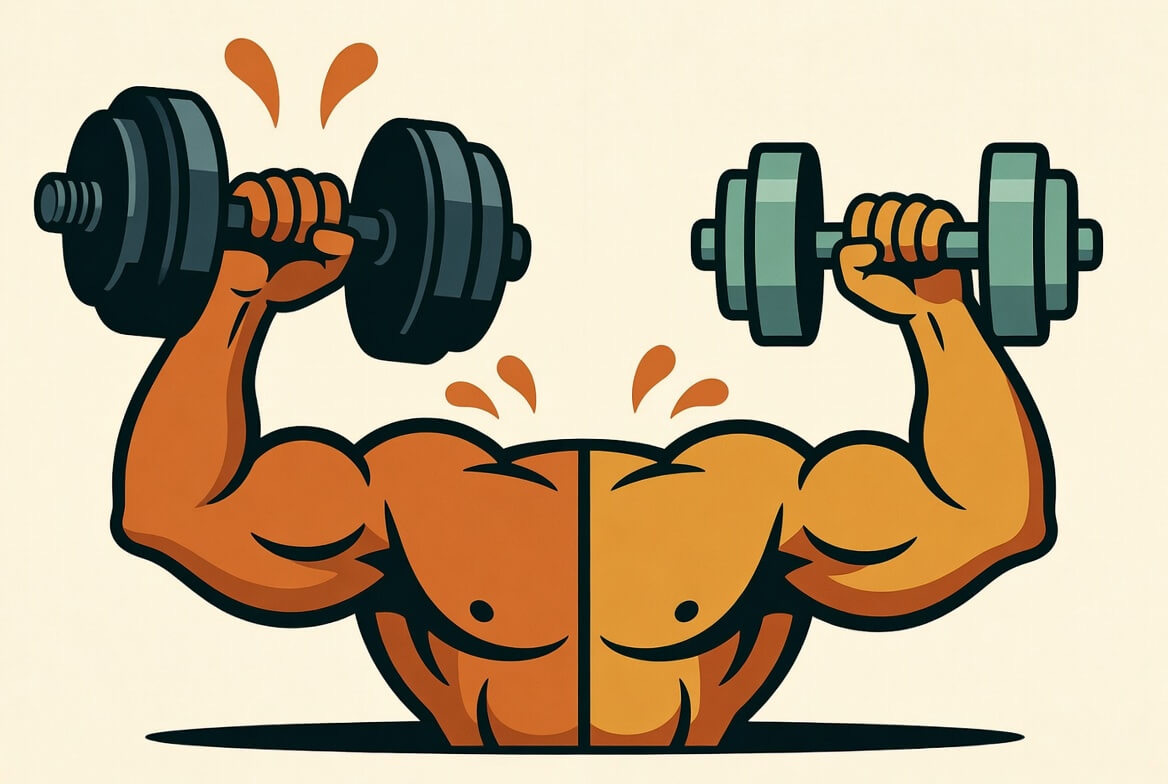
You know that paralyzing indecision standing in front of the dumbbell rack? On one hand, you have the “go heavy or go home” crowd telling you that unless you’re lifting near-maximal loads, you’re just doing cardio. On the other hand, the high-rep advocates swear that the “burn” is where the growth happens.
For ages, I’ve bounced between these two camps, wondering if I’m wasting my time unless I hit a specific rep range. I’ve come around to simply enjoying the struggle—channeling a bit of that inner David Goggins and muttering “good” when the lactic acid kicks in—but there was always a nagging doubt that I might be working hard for suboptimal results.
A new study published in The Journal of Physiology has effectively closed the casket on this debate. It turns out the secret sauce isn’t the plate math; it’s the grimace on your face. As with most things in life, the specific path matters less than the maximal effort you apply to it.
“Variation in RET-induced muscle hypertrophy occurred independent of external load and was relatively well conserved (i.e., retention of the hypertrophic response) across different anatomical limbs within an individual.”
What’s the Big Idea?
Researchers at McMaster University ran a clever experiment to isolate the variable of “weight” versus “effort.” Rather than comparing two different groups of people (which introduces messy genetic variables), they used a within-subject design on twenty healthy young men.
Here is the setup:
One side of the body (arm and leg) trained with High Load (heavy weight, 8–12 reps).
The other side trained with Low Load (lighter weight, 20–25 reps).
Everything else was identical. But here is the kicker: every single set was taken to “volitional fatigue.” This means they lifted until they physically could not move the weight another inch with good form.
The results killed the bro-science. After 10 weeks, both sides grew the same amount. Muscle thickness, cross-sectional area, and muscle fiber size increased almost identically regardless of whether the subject was heaving a heavy weight or rep-ing out a light one.
The study found that muscle growth is mediated by endogenous factors (your internal biology) rather than exogenous ones (the specific weight on the bar). Basically, if you are a “high responder” to training, your heavy-lifting leg grew and your light-lifting leg grew. If you were a “low responder,” you struggled to grow on both sides. The load didn’t change your destiny; your effort and your biology did.
💡 In Plain English
Think of muscle growth like flipping a stubborn light switch. It doesn’t matter if you force it down with a heavy crowbar or push repeatedly with your thumb; the light only turns on if you apply enough pressure to make it finally click. Your body ignores the specific tool you used and only responds to the signal that your limit was reached.
Why It Matters and What You Can Do
This frees you from the tyranny of the “perfect” program. Many of us obsess over percentages of our 1-rep max, thinking there is a magic number that unlocks growth. This data suggests that the mechanical sensing machinery in your muscles is remarkably indifferent to the weight, provided the effort is high.
Here is how you apply this to your next workout:
Go to the dark place: The non-negotiable variable here is failure. If you lift light weights and stop when it gets “kind of hard,” you won’t grow. You have to push until you can’t complete the rep.
Save your joints: If heavy squats make your knees scream, drop the weight and double the reps. You lose nothing in terms of muscle gains, provided you push to exhaustion.
Mix it up: You don’t have to choose a tribe. You can do heavy compounds for the fun of moving big iron, and high-rep isolation movements to save your tendons. The biological outcome is the same.
What’s Next on the Horizon
This study points toward a future where we stop looking for the “perfect workout” and start looking at the “perfect body.” Since the variability in growth was determined by the individual’s biology (conserved across upper and lower limbs), future research is likely going to pivot toward why some people grow like weeds and others don’t, regardless of effort.
We are moving away from arguing about sets and reps and moving toward understanding gene expression, satellite cell availability, and capillary density. The next frontier isn’t a new training modality; it’s personalized biology.
Safety, Ethics, and Caveats
Before you grab the pink dumbbells and expect to look like a bodybuilder, we need a reality check.
First, “volitional fatigue” with high reps is mentally brutal. Doing 25 reps to true failure hurts—a lot. It causes significant metabolic stress (the burn). Most people unconsciously stop 3 or 4 reps short because of the pain, not because of true muscular failure. If you can’t tolerate the suffering, heavy weights (where failure happens faster) might actually be “easier” for you to execute properly.
Second, strict failure increases the risk of form breakdown. Whether you are grinding a heavy double or shaking through your 25th rep, if your form degrades, your injury risk spikes.
Finally, while size gains were identical, strength gains (1RM) often favor the heavy lifters slightly—mostly because lifting heavy is a skill. If you want to be good at lifting heavy things, you occasionally have to lift heavy things.
One Last Thing
Stop overthinking the numbers. Pick a weight you can control, move it until you physically can’t anymore, and trust the process.