

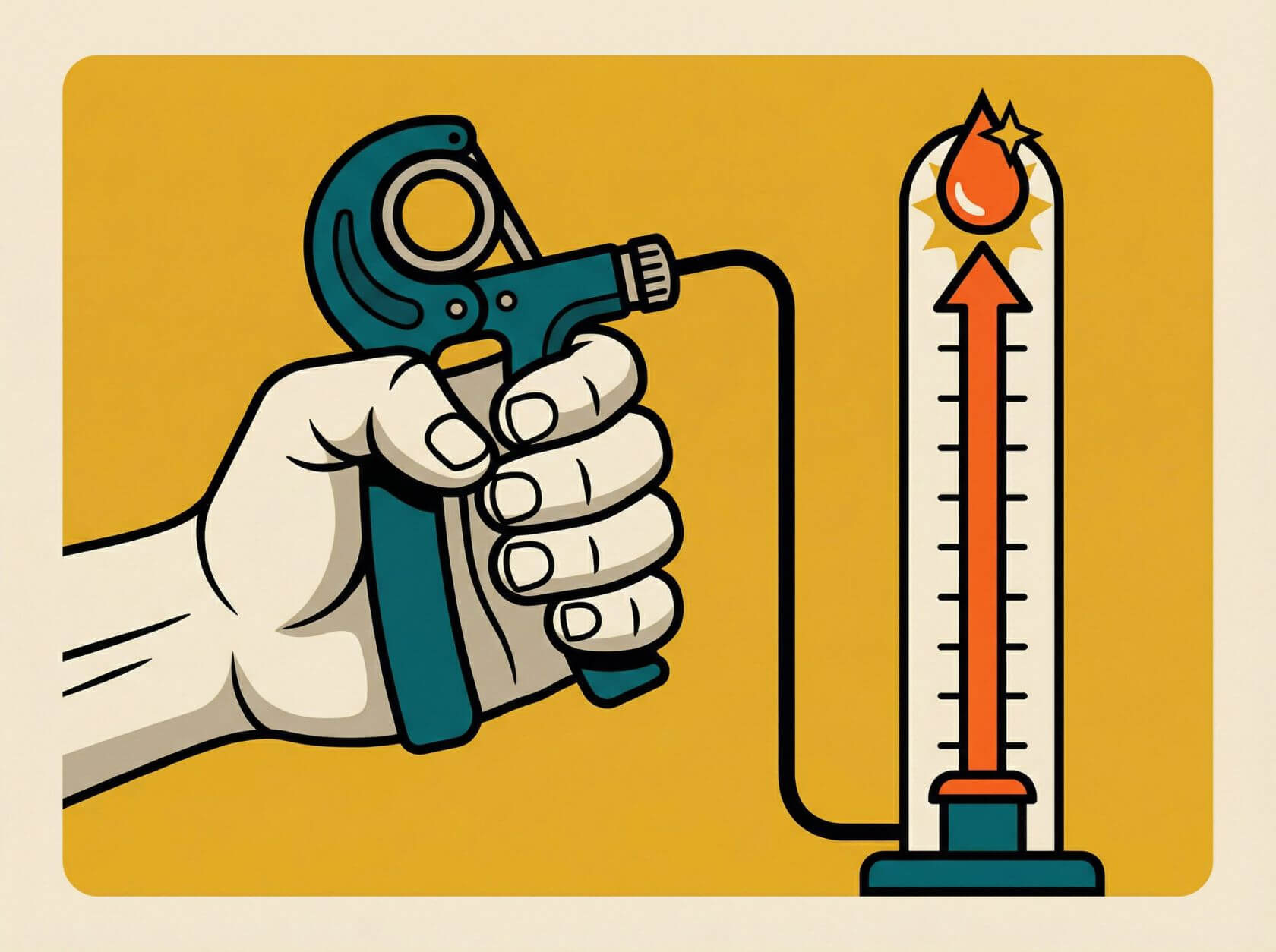
Look, building a crushing grip isn’t just about party tricks or opening stuck pickle jars. Whether you’re hauling heavier farmers carries, ripping deadlifts, or just hanging from a bar until your forearms scream, working your grip is arguably the single highest-ROI investment you can make in your physiology. It’s a total no-brainer.
For years, we’ve treated grip strength as a secondary metric—something that happens while you’re busy training the “glamour muscles.” But a fascinating study digging into the National Health and Nutrition Examination Survey (NHANES) data suggests we’ve got it backward. Your grip isn’t just a byproduct of strength; it’s a loud, screaming signal about the state of your hormones.
Specifically, your testosterone.
“Undoubtedly, the process of aging begins earlier than we expected.”
What’s the Big Idea?
We usually think of sarcopenia (muscle loss) and low testosterone as problems for the geriatric ward—something to worry about when you’re 80. But the data tells a much scarier, more immediate story.
Researchers Chiu, Shih, and Chen decided to look at a massive dataset of over 7,000 Americans. And they didn’t just look at the elderly; the average age of the participants was roughly 36. They wanted to see if there was a direct line between how hard you can squeeze a dynamometer and the level of testosterone floating in your blood.
I’ve spent decades unintentionally turning my forearms into steel cables through rock climbing and heavy deadlifts. I honestly thought I was just trying to not fall off the wall or drop the bar. Turns out, I was likely monitoring my endocrine system the whole time.
The researchers found a “dose-dependent” relationship. That’s science-speak for: as grip strength goes up, testosterone goes up. As grip strength goes down, testosterone crashes. This held true across the board, even after they adjusted for things like age, race, and BMI.
Here is the wild part: this link was significant even in young, healthy people. We assume a 35-year-old is safe from the “aging process,” but this study implies that if your grip is weak now, your hormones might already be checking out. The authors explicitly state that the decline in physiological function—specifically the loss of strength associated with lower T—starts much earlier than the medical community previously admitted.
💡 In Plain English
Think of your grip strength less like a muscle and more like your body’s “Check Engine” light. When that light flickers—manifesting as a weak handshake or inability to hang from a bar—it’s often the first warning sign that the engine (your testosterone and metabolic health) is struggling, long before the car actually breaks down.
Why It Matters (and What You Can Do)
So, what does the data actually say about your training?
The study highlights a concept called dynapenia. It’s different from just having small muscles; it’s about having weak muscles. You can be big and puffy but functionally weak (dynapenic). The study showed that higher testosterone levels were a massive shield against this type of weakness.
Conversely, if you are visually skinny-fat or obese and have a weak grip, you are in a statistical danger zone for low T. The study found the correlation between grip and T was slightly stronger in non-obese people, but it was present everywhere.
If you want to stay on the correct side of this equation, you need to stop treating your hands like hooks and start treating them like engines.
Ditch the straps (mostly): Unless you are pulling a max-effort deadlift that exceeds your grip capacity, use your bare hands or chalk. Force the adaptation.
Heavy Carries are King: The study measured isometric force (squeezing and holding). Farmers carries are essentially moving isometric tests. Go heavy.
The “Dead Hang” Test: Start your mornings or end your workouts by hanging from a bar. Aim for 60 seconds. If you can’t hold your own body weight, that is your primary red flag.
Don’t Ignore Body Composition: The data showed that while the grip/T relationship exists for everyone, obesity complicates the signal. Leaning out while getting stronger is the golden ticket.
What’s Next on the Horizon
The most optimistic takeaway here is the potential for early detection. Right now, diagnosing hypogonadism (low T) usually requires blood work, which most guys under 40 never get.
The authors of this paper are suggesting something radical: standardization. In the future, a simple grip test at your annual physical could be the first line of defense. If your numbers are low, it triggers a deeper look at your hormones before you suffer the long-term effects of low T (like depression, fatigue, and frailty).
We might move toward a model where we treat grip strength like blood pressure—a vital sign that gets checked every time you walk into a doctor’s office.
Safety, Ethics, and Caveats
Let’s pump the brakes for a second.
This was a cross-sectional study. That means it’s a snapshot in time. It shows association, not causation.
Crucial distinction: The data does not prove that buying a stress ball and squeezing it while watching Netflix will magically inject testosterone into your veins. It shows that people with high T tend to have strong grips, and people with strong grips tend to have high T.
It’s a bidirectional relationship. Testosterone drives protein synthesis and muscle function, which makes you stronger. But training for strength also supports healthy hormone levels. Don’t interpret this as “squeezing things replaces TRT.” It doesn’t. But it is a very accurate barometer of your systemic health.
One Last Thing
Your hands are your interface with the world. If that interface is weak, the system running it probably is, too. Go lift something heavy.
Explore the Full Study
Examining the association between grip strength and testosterone