

One of the strangest things I noticed while taking a cycle of Epitalon was that it deleted my seasonal allergies. But when spring pollen hit, I noticed an anomaly: my physiological stress response was still firing—my heart rate still spiked from the sheer payload of the pollen exposure—but the mucosal symptoms, the red eyes and runny nose, vanished.
Epitalon is a synthetic four-amino-acid chain. The precise Ala-Glu-Asp-Gly structure (often abbreviated as AEDG) was synthesized by scientists V.K. Khavinson and V.N. Anisimov, who modeled it after Epithalamin, a natural bovine pineal gland extract. It wasn’t until 2017 that researchers finally tracked down the physical peptide in actual pineal gland extract.
If you go digging through the literature or commercial LC-MS/MS reports looking to verify purity (usually seeing it delivered as an acetate or TFA salt), you’ll run into academic drama. Some recent structural papers actively misreported the compound, drawing a “double-gamma bonded” variant by mistake, leading researchers to actively test for counterfeit risks involving a similar Glu-Ala-Asp-Gly peptide. But the actual, proven structure remains the standard AEDG tetrapeptide chain.
Key takeaways
Epitalon overcomes cellular division barriers in human somatic cells, displaying an average 33.3% increase in telomere elongation when tested under the TRAP protocol.
The peptide demonstrates targeted tissue rescue, driving a 43.9% improvement in retinal functional activity in experimental visual degeneration models.
The chemical operates through a “distant reception” phenomenon, exhibiting peak systemic signaling efficiency at ultra-low concentrations between 10^-17 and 10^-15 M.
The Nuclear Pathway and Cellular Geroprotection
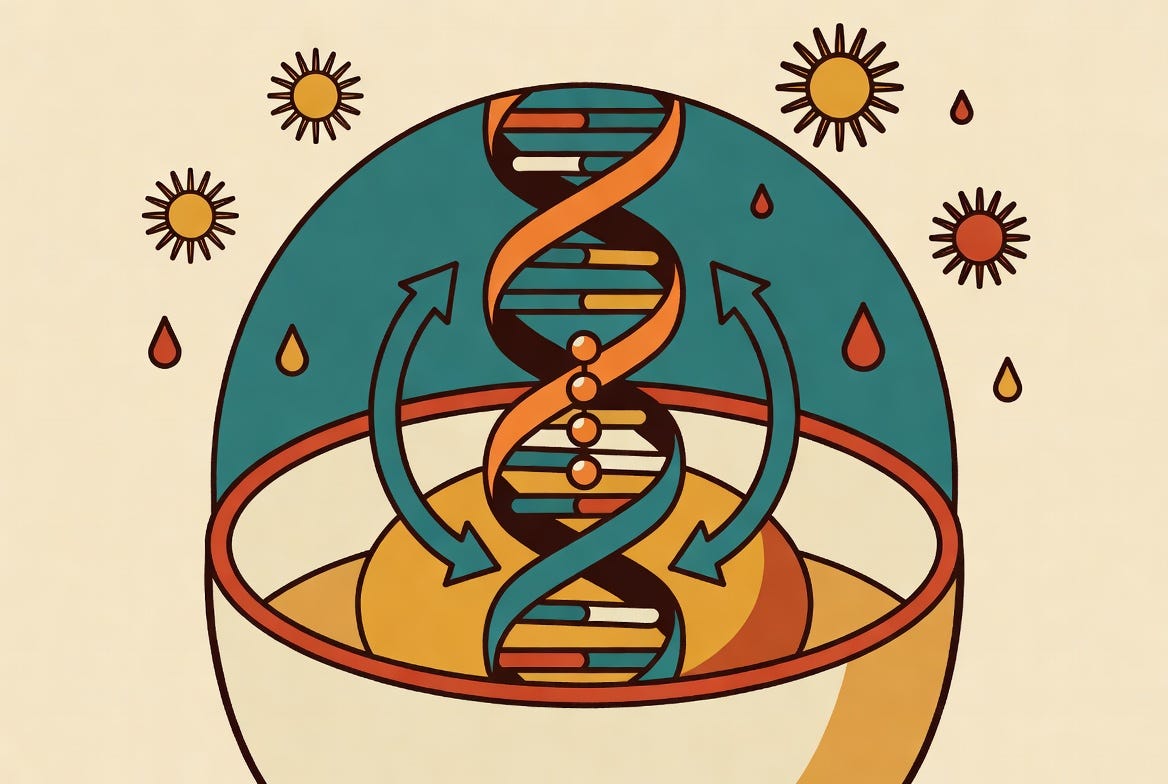
Once you get past the structural confusion, you’re left with a bigger question: how does a simple tetrapeptide actually change how a cell ages? The answer is that Epitalon isn’t floating in the bloodstream hoping to bump into a receptor. It’s highly membrane-permeable. When researchers tagged it with fluorescein isothiocyanate to track its movement, they watched it cross the cell wall and drive straight into the nucleus.
Once inside, it binds physically to targeted epigenetic DNA motifs. It searches out CAG sequences and ATTTC/ATTTG motifs—segments of our DNA normally prone to cytosine methylation—and interacts directly with the telomerase gene promoter.
That direct docking explains the peptide’s most famous claim: it turns on telomerase enzyme components. In cultured human fibroblasts, applying the peptide pushed cellular division well beyond its normal biological boundary, overcoming the Hayflick limit and keeping the cells dividing smoothly from passage 34 right past passage 44.
This isn’t just an abstract in vitro trick. Running a TRAP protocol (Telomere Repeat Amplification Protocol) shows physical telomere elongation of 33.3%, plus a 1.56x to 2.44x drop in senescence markers like p16/p21 in stem cell models. In live animal models, researchers clocked a 16% increase in the total lifespan of Drosophila melanogaster, with comparable protective geroprotection appearing in Nicotiana tabacum botany studies.
Telomere extension provides long-term effects, but it doesn’t explain the immediate relief I saw.
The answer to the allergy anomaly lies in how Epitalon immediately redirects systemic immune function and antioxidant defenses long before any lifespan effects materialize. When it hits the system, it rapidly upregulates IL-2 mRNA and modulates the blast transformation of murine thymocytes. It’s shifting the thymus and lymphocyte activation rules on the fly, reorganizing intense systemic inflammatory responses.
At the metabolic level, it triggers a non-receptor-mediated pathway by hitting Keap1/Nrf2 promoters. That mechanism upregulates the synthesis of our heaviest endogenous defense enzymes, specifically SOD-1 and NQO1, alongside catalase. The net result is a chemical block against the formation of reactive oxygen species (ROS). It also provides an antihypoxic shield. When NB7 cells were placed under severe oxygen-deprived stress, the peptide halted the expected crash in specific enzyme concentrations, yielding a 10–15% rescue in levels of IDE and NEP mRNA. Melatonin synthesis is heavily intertwined with these systems, which likely explains why this bare-bones four-amino-acid synthetic often shows clinical superiority to its parent extract, Epithalamin, at significantly lower physiological doses.
As you step away from systemic immunity into highly specific local tissues, the literature becomes a series of targeted salvage operations. In treating neurodegeneration, the peptide increases insulin-degrading enzyme (IDE) and neprilysin (NEP) while modulating the metabolism of amyloid precursor protein. In Wistar rats, it significantly boosted neurological function by increasing the quantity and length of dendrites, while simultaneously regulating cholinergic enzymes like AChE and BuChE.
The physical tissue recovery extends far beyond the brain. In reproduction models, it scrubs ROS and apoptosis out of MII oocytes, significantly improving blastocyst expansion and hatching rates in post-thawed embryos. In models of severe visual loss like Retinitis pigmentosa, treating Campbell rats with the peptide preserved their retinal structure and drove a 43.9% improvement in how well their eyes actually worked.
Then there’s the cancer data. Epitalon suppresses tumor growth while it protects healthy tissue. It reduced both tumor incidence and multiplicity in CBA mice. It physically shrinks tumors in specific transgenic rodent cohorts.
When an aggressive breast cancer model was induced via 1,2-dimethylhydrazine, Epitalon drove up to a 3.7-fold reduction in HER-2/neu mRNA expression. Even against brutal chemotherapies, it demonstrates nephroprotective effects that shield the kidneys from cisplatin-induced damage.
All of this highly documented cellular repair comes with a bizarre pharmacological catch that flies in the face of normal biohacking logic: taking more of it ruins the effect.
Epitalon operates through a weird biological quirk called the “Distant Reception” phenomenon. In pharmacology, you’d assume the effect scales with the dose until you hit saturation. Instead, researchers found that Epitalon’s peak signaling happens at ridiculously low concentrations—down at 10^-17 to 10^-15 M. It acts more like a master biological telegraph than a traditional threshold drug, relying on complex antioxidant and immune cascades to do the heavy lifting rather than saturating the tissue directly.
That ultra-low signaling environment dictates how it gets into the cell, using LAT1/PEPT1 transporters. Labs are currently testing lysine dendrimers as carriers to keep the peptide intact for oral use. A tiny, protected exposure is enough to flip the gene promoters, modulate the thymus, and occasionally, accidentally, turn off an allergic reaction you never even meant to target.
Frequently Asked Questions
What does the peptide Epitalon do?
Epitalon is a synthetic tetrapeptide that enters the cell nucleus to interact directly with telomerase gene promoters, effectively overriding cellular division limits. Beyond telomere lengthening, it triggers systemic antioxidant responses by upregulating enzymes like SOD-1 and catalase, while modulating immune function through the thymus.
Does Epitalon make you look younger?
While the compound is associated with cellular geroprotection and improved tissue health, it is primarily studied for its impact on DNA methylation, telomere length, and systemic inflammation rather than cosmetic anti-aging. Its ability to shield against reactive oxygen species and support tissue repair may improve systemic health markers, but it is not a direct dermatological treatment.
How do I know if Epitalon is working?
Users may notice non-traditional indicators, such as a shift in how the body handles environmental stressors or systemic immune responses. Because it operates through a phenomenon called distant reception, the effects are often subtle and metabolic rather than immediate physical sensations like those associated with stimulants.
How often should you use Epithalon peptide?
Because the peptide exhibits peak signal efficiency at ultra-low concentrations—between 10^-17 and 10^-15 M—higher dosages can actually be counterproductive. Its unique biological profile suggests that the system responds better to minimal, precise signaling rather than the heavy saturation common with other pharmacological interventions.
What is the difference between Epitalon and Epithalamin?
Epithalamin is an extract derived from the bovine pineal gland, while Epitalon is a synthesized, four-amino-acid peptide chain modeled specifically after that extract. Epitalon is generally considered more effective because it provides a pure, consistent structure that avoids the biological variability of gland-sourced extracts.
Can I trust the purity of the Epitalon I buy?
Purity is a significant concern because academic literature has historically misreported the structural sequence, leading to the circulation of incorrect peptide variants. When verifying quality, one must ensure the product confirms the standard AEDG tetrapeptide structure rather than flawed alternatives like those with double-gamma bonding.
Why does Epitalon require such a low dosage to be effective?
It relies on a mechanism known as distant reception, where the peptide acts as a biological signaling trigger rather than a mass-delivered substrate. Once it reaches specific DNA motifs in the cell nucleus, it initiates cascading metabolic and antioxidant effects that do not increase in efficacy with heavy saturation.