

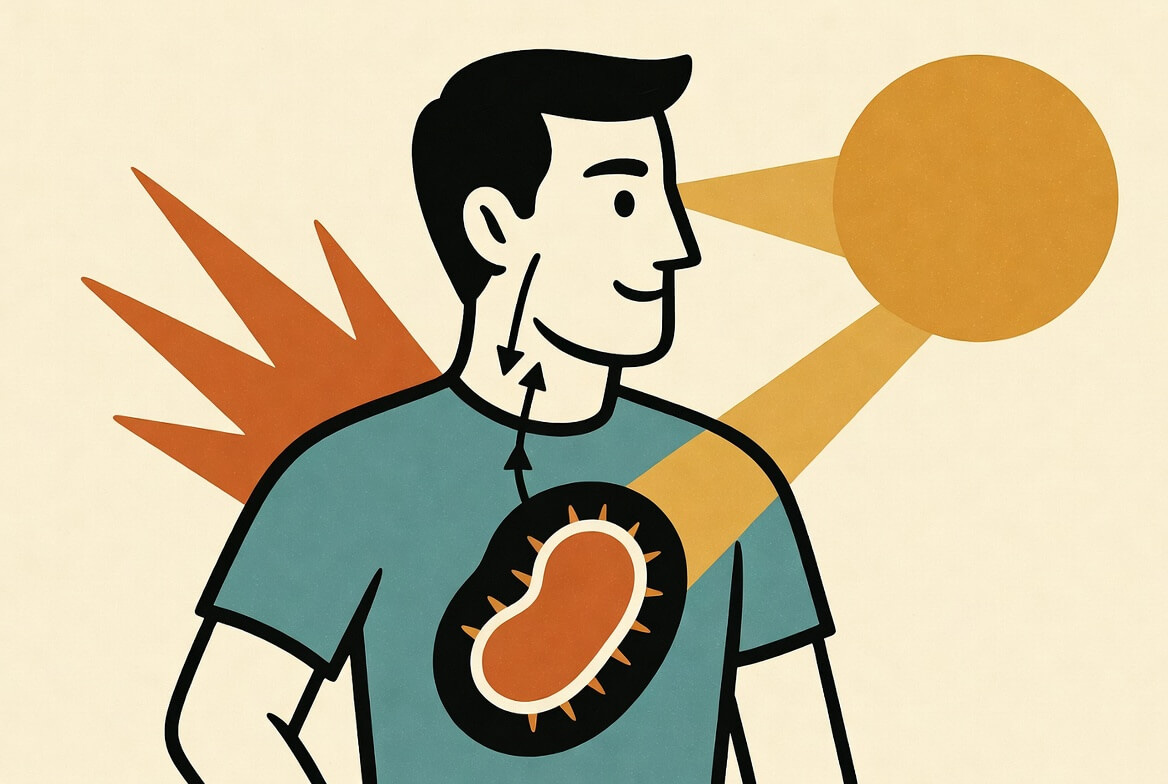
I know the current trend among the longevity elite—the Bryan Johnsons of the world—is to treat the sun like a radioactive laser beam. The protocol seems to be: flee into the shadows, slather on zinc, and preserve your collagen at all costs.
But I’m taking a different stance.
Despite the vampire-chic aesthetic of the anti-aging community, most people could stand to get a hell of a lot more sun. This is especially true if, like me, you live in a region where the winter sky looks like a wet sheet of gray paper for four months straight. We tend to think of the sun solely as a Vitamin D dispenser or a skin cancer risk, but a new study out of UCL suggests it’s doing something much weirder—and much more important—than synthesis or damage.
It turns out, you are not as solid as you think you are. And the light passing through you might be charging your system in ways we are just starting to understand.
“Our data show that longer wavelengths of sunlight penetrate through the human body and... have the ability to improve function. While infrared light has been used on targeted tissues, its ability to improve distal tissues in humans has not been explored.”
What’s the Big Idea?
Here is the simple, somewhat unsettling premise of the study: researchers took a group of people, stood them in the sun (or in front of an 850 nm LED panel), and measured how much light came out the other side of their bodies.
Specifically, they were looking at the thorax—your chest and back. They put a sensor on the chest, blasted light at the back, and found that near-infrared (NIR) wavelengths (around 850 nm) traveled straight through the tissue, ribcage, and organs.
This isn’t just a party trick. The study wasn’t merely checking if we are translucent; they wanted to know if this “pass-through” light actually did anything.
The researchers covered the participants’ heads in aluminum foil to ensure no light hit their eyes. Then, they exposed the participants’ backs to this near-infrared light for 15 minutes. Twenty-four hours later, they tested the participants’ vision.
The results were wild. The subjects showed a significant improvement in color contrast sensitivity.
Let’s pause on that. They shone a light on their backs, blocked their eyes completely, and their vision improved the next day.
This confirms a biological phenomenon called the “abscopal effect.” Essentially, the light interacts with the mitochondria (the power plants) in the cells of your back. This boosts ATP production (energy) and likely triggers a signaling cascade—possibly through cytokines in the blood—that tells the rest of the body, including the retina, to shape up. You charge the battery in the torso, and the headlights get brighter.
💡 In Plain English
Think of your body less like a house with separate rooms and more like a car with a central battery. Boosting mitochondrial power in your back is like charging the battery in the trunk; the surge in energy travels through the system and makes the “headlights” (your eyes) burn brighter, even though you never touched the bulbs.
Why It Matters and What You Can Do
We have spent the last two decades stripping these specific wavelengths out of our lives. Modern energy-efficient lighting—white LEDs—are fantastic for your electric bill but terrible for your mitochondria. They spike in the blue spectrum and flatline in the red and near-infrared. We are effectively living on a light diet of empty calories.
The study authors point out that this “spectral diet” of modern buildings might be a public health blind spot. We are missing the regenerative wavelengths that have been part of our evolution for millions of years.
So, how do we fix this?
1. Get outside (clothed or not).
One of the most practical findings here is that clothing isn’t a barrier. The researchers tested t-shirts, shirts, and wool sweaters. The 850 nm light punched right through them. You don’t need to be naked to get the benefits. If you can get more sun, do it. Just take steps to avoid sunburn and be reasonable. You don’t need to roast; you just need exposure.
2. Supplement with Tech.
If you live in a cold climate or are stuck in an office, technology can bridge the gap. Personally, I use a red light panel every day. I sit in front of it for brain and eye health, but I’ve noticed it seems to improve my heart rate variability (HRV)—a key metric of stress and recovery.
Subjectively, it also improves my mood during the dark, cold winter months. It feels like a way to “hack” that mitochondrial charge when the sun is hiding behind the clouds. If you can afford a panel that hits these wavelengths (specifically in the 800nm–860nm range), it’s a worthy investment.
3. Rethink “Systemic” Health.
We used to think you had to treat the specific organ to fix the problem. If your eyes are failing, treat the eyes. This data suggests the body is far more networked than that. Improving mitochondrial function in your largest surface area (your skin) can upgrade your central nervous system.
What’s Next on the Horizon
This research opens the door to what the authors call “Green Chemistry” inside the human body at 37°C.
If specific wavelengths can accelerate redox reactions in our cells without heating them up, we might be looking at a future where we treat systemic metabolic decline not just with pills, but with light. The study hints that these wavelengths might help counteract the decline in mitochondrial membrane potential that comes with aging.
We might see a shift in architectural lighting standards, moving away from “pure white” LEDs toward full-spectrum lighting that mimics the solar distribution. Imagine offices that charge your cellular batteries while you work, rather than slowly draining them with blue-light stress.
Safety, Ethics, and Caveats
Before you convert your home office into a tanning salon, we need to cover the risks.
There is a massive distinction—one that keeps dermatologists up at night—between the therapeutic near-infrared light discussed here and the UV radiation that causes melanoma. The sun contains both. The researchers are isolating the benefits of the longer wavelengths (850 nm), which do not burn the skin.
When I say “get more sun,” I am saying be reasonable. The user who burns to a crisp is doing more inflammatory damage than mitochondrial good.
Also, be careful with the “red light” consumer market. The study found that while 850 nm penetrates deep, the visible red light at 670 nm (which is very common in cheaper devices) does not transmit through the body nearly as well. It gets absorbed too quickly. If you are buying a panel, check the specs. You want the invisible infrared, not just the pretty red glow.
One Last Thing
We often think of our bodies as barriers—fortresses that keep the outside world out. It’s humbling to realize we are actually permeable, walking around collecting energy from the sky. Go get some light.
Explore the Full Study
Longer wavelengths in sunlight pass through the human body and have a systemic impact which improves vision
Glen Jeffery, Robert Fosbury, Edward Barrett, Chris Hogg, Marisa Rodriguez Carmona & Michael Barry Powner. Scientific Reports, 2025.