

Most of us view “showing off” as a character flaw. We tell ourselves that true discipline happens in the dark, in the empty garage gym at 5:00 AM, driven by internal grit rather than external validation. We try to convince ourselves that we lift solely for us.
That is a lovely sentiment. It is also biologically incorrect.
There is a primitive switch in your brain that flips the moment another pair of eyes lands on you. You’ve probably felt it—that sudden spike in adrenaline when you walk into a crowded weight room, or the mysterious ability to run faster when passing a group of strangers. The data suggests this isn’t just in your head. The secret to breaking your plateau might not be a new supplement or a complex periodization block.
It might just be a spotter. Specifically, a spotter you want to impress.
“Men added nearly 20 pounds to their leg press max simply because two women were standing in the room.”
The Science of “Watch This”
We need to look at a fascinating study out of Samford University involving college students, heavy iron, and the power of the “opposites attract” dynamic.
The researchers, led by Steven C. Baker, recruited roughly 50 resistance-trained men and women. They wanted to test a psychological concept called “social facilitation”—the idea that human performance changes when we have an audience. They set up a simple experiment: participants had to find their One Repetition Maximum (1-RM) on the bench press and the leg press.
They did this twice.
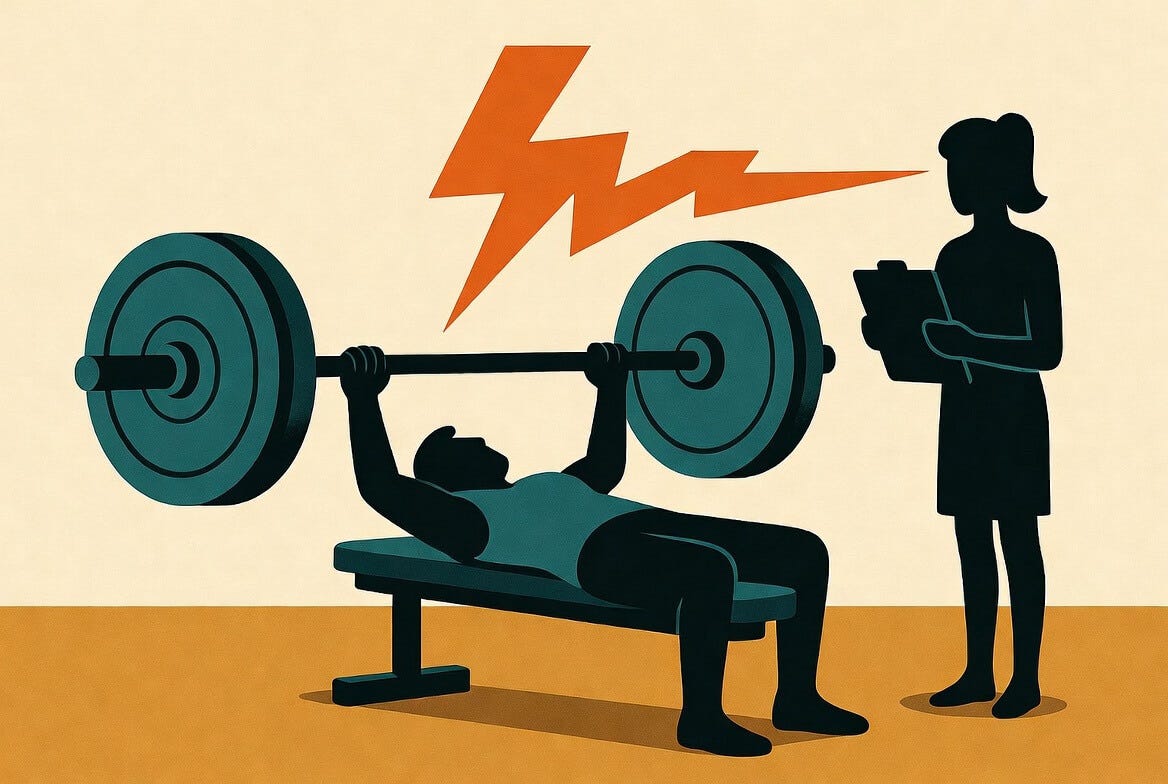
In the first trial, the lifters were alone with the tester (a male). In the second trial, the room included an audience: two “observers” of the opposite gender. These strangers didn’t yell, they didn’t hype the lifters up, and they didn’t offer verbal encouragement. They just stood there and watched.
The results weren’t subtle.
When the men realized they were being watched by women, their strength spiked. They added an average of 4.2 pounds to their bench press and a massive 18.8 pounds to their leg press.
The women weren’t immune to the pressure, either. When observed by men, the female participants added nearly 10 pounds to their leg press and saw significant jumps in their bench press strength.
This blows a hole in the idea that strength is a fixed mechanical output. Your muscles didn’t change in the five minutes between walking in the door and hitting the bench. Your neural drive did. The presence of the opposite sex unlocked a reserve of force that “internal motivation” couldn’t touch.
💡 In Plain English
Think of an audience like a shot of nitrous oxide in a car engine. It provides a massive boost for a drag race (straightforward lifting), but if you use that same burst of power while parallel parking (complex skill work), you’re going to crash. Social pressure cranks up your engine's output, but it degrades your steering.
Why It Matters (and How to Use It)
The implications here go beyond simple ego lifting. This study suggests that we are chronically undertraining when we train in isolation. We think we are pushing to failure, but our “solitary failure” is arguably 5% to 10% lower than our “social failure.”
If you are training for maximum strength, isolation is the enemy. Here is how to weaponize this biology:
Ditch the Home Gym on Heavy Days: If you have a 1-RM test coming up, go to a commercial gym. The mere presence of strangers—even if they aren’t looking directly at you—creates a baseline of arousal that heightens performance.
The “Date” Variable: The study specifically controlled for opposite-gender observers. While general crowds help, the evolutionary “mating signal” seems to provide a stronger voltage. Train with a partner of the opposite sex, or at least train during peak hours when the gym is diverse.
Silence is Golden: Note that the observers in the study didn’t scream “LIGHT WEIGHT BABY!” They just observed. You don’t need a hype man; you just need a witness.
The Danger: The “Choking” Paradox
Before you go invite the cute barista to watch you max out, we need to address the dark side of social facilitation. There is a reason this works for bench pressing but fails for calmer, more precise activities.
I learned this lesson the hard way. Years ago, I was at a rock climbing gym, feeling pretty good about my skills. Then I saw a literal child—maybe ten years old—scampering up a wall that had been giving me trouble. Naturally, my brain decided this was unacceptable. I needed to establish dominance. I decided to show this kid (who definitely did not care) “what’s what.”
I climbed faster, more aggressively, and with significantly more ego than technique. I reached for a hold, pulled dynamically with everything I had, and felt a snap. I tore a bicep. I couldn’t climb for months. I felt like an absolute idiot.
The research explains exactly why my bicep snapped while the bench pressers in the study got stronger.
Social facilitation improves performance on simple, high-force tasks (like pushing a bar away from your chest). However, when the task is complex, skilled, or new (like technical rock climbing or juggling), an audience causes “choking.” The increased arousal destroys your focus and fine motor control.
Safety, Ethics, and The Ego Trap
If you assume that the “Hot Spotter” effect is free money, you’re going to get hurt. The college students in the Baker study saw strength gains, but the study didn’t track injury rates weeks later.
When you lift more simply because someone attractive is watching, you are bypassing your brain’s natural safety governors. Your neurological inhibition—the thing that says “too heavy, stop”—gets muted by the desire to perform. This puts your tendons and ligaments in the line of fire. Your muscles might be strong enough to impress the observer, but your connective tissue might not be ready for the load.
The Protocol:
Use the audience for “Grind” lifts: Squats, deadlifts, presses, and sled pushes are perfect candidates for social motivation.
Hide for Skill work: When learning a snatch, working on mobility, or climbing a technical route, do it alone. You need focus, not arousal.
Check your ego at the door: If you feel the urge to show up a 10-year-old at the climbing gym, take a breath. The audience enhances power, not invincibility.
One Last Thing
We are social animals who evolved to perform for the tribe. You can pretend you don’t care what people think, or you can accept that you’re a primate who lifts heavier weights when the stakes feel real. Bring a friend. Maybe even a cute one.
Explore the Full Study
Baker, S. C., Jung, A. P., & Petrella, J. K. (2011). “Presence of Observers Increases One Repetition Maximum in College-age Males and Females.” International Journal of Exercise Science. Read the full paper here.