

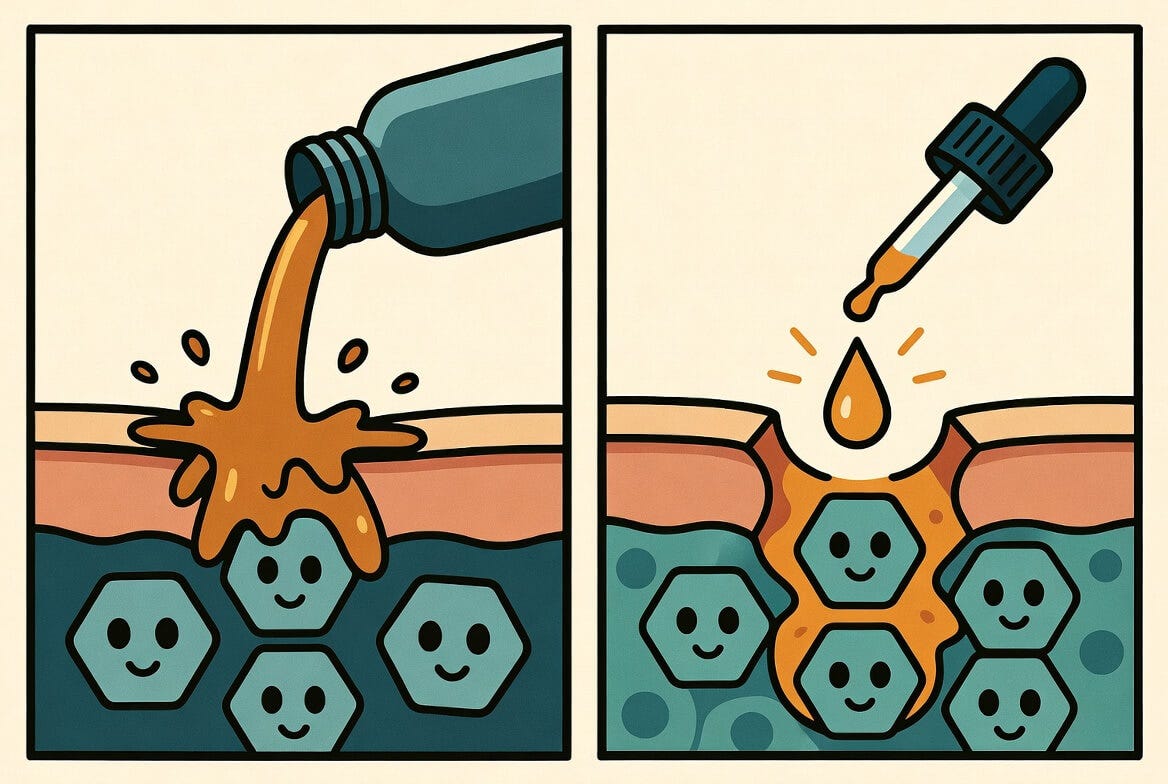
Let’s be real for a second. DMSO (dimethyl sulfoxide) is the weird uncle of the health supplement family. It smells like garlic, it comes from wood pulp processing, and it has a cult following that swears it cures everything from sprained ankles to interstitial cystitis.
It’s been sitting in medicine cabinets for over fifty years, and the consensus has usually been: slap it on.
But I’ve been thinking a lot about dosage lately. I’ve been playing around with DMSO myself—mostly trying to coax my hair follicles into waking up (a story for another day)—so I’ve had skin in the game, quite literally. I’ve always operated under the assumption that if a little is good, a lot is probably better.
Turns out, I was wrong. And if you’re using it, you might be too.
A fascinating paper out of the British Journal of Pharmacology just dropped some hard data on how DMSO actually interacts with skin wounds. The findings validate something I’ve suspected but ignored: DMSO is safe and powerful, but if you decide to try it, you have to start with a crazy small, diluted dose.
Here is the wild part: The concentration that worked best in the lab wasn’t the 99% purity stuff you buy on Amazon. It wasn’t even 50%. It was a micro-dose.
“DMSO significantly accelerated wound closure at low concentrations, especially 5 mM, but delayed wound healing at high concentrations.”
What’s the Big Idea?
The researchers wanted to know if DMSO could fix one of the most stubborn problems in medicine: diabetic wounds. These are injuries that refuse to close because the cellular machinery in a diabetic system is essentially on strike.
They took diabetic mice (whose skin behaves similarly to diabetic human skin) and treated their wounds with varying strengths of DMSO.
Here is the thing about biology: it loves balance. The researchers found that DMSO acts like a light switch for the Akt/mTOR pathway. You don’t need a PhD to understand this pathway—just think of it as the construction foreman of your cells. When Akt/mTOR is active, it screams at the cells to build proteins, divide, and fix things.
When they applied a specific, low concentration of DMSO (5 millimolar, or mM), it was like giving that foreman a double espresso.
Fibroblasts (the builders) started multiplying.
Collagen (the bricks) was laid down faster.
TGF-β1 (the signal) was released, telling skin cells to migrate across the wound and close it.
But here is the catch—and it’s a big one. When they bumped the concentration up to just 20 mM, the healing actually slowed down. It got worse than doing nothing at all.
This explains so much about the mixed reviews DMSO gets online. One person swears it healed their scar overnight; another says it irritated their skin and did nothing. They were probably just using different buckets of paint.
💡 In Plain English
Think of your damaged cells like a construction crew that has walked off the job. A low dose of DMSO acts like a shot of espresso, waking them up and getting them back to building tissue, whereas a high dose over-caffeinates the system and actually slows down the repair. Biology often favors a nudge over a shove, and in this case, a micro-dose flips the genetic switches for healing that a mega-dose paralyzes.
Why It Matters and What You Can Do
If you are like me and you’re already tinkering with this stuff—whether for hair growth, joint pain, or scar tissue—this paper changes the playbook. It suggests that DMSO isn’t just a solvent that drags drugs through your skin; it’s an active biological signal that works on a bell curve.
Most people buy 99.9% DMSO and dilute it to maybe 70%. Based on this study, that might be overkill for wound healing. 5 mM is a tiny fraction of a percent. While mice aren’t humans, the mechanism (mTOR activation) is conserved across species.
Here is how to apply this logic to your own routine:
Dilute, Then Dilute Again: The “more is better” approach is dead. If you are applying this to broken skin or scar tissue, you want a whisper of DMSO, not a shout.
Treat It Like a Signal, Not a Salve: You aren’t trying to burn off a wart. You are trying to nudge a signaling pathway. Think of it as homeopathic-style dosing but with actual molecular weight behind it.
Watch for the “Stall”: If you’ve been using a high strength and seeing zero results (or irritation), you might have hit that 20 mM “delay” threshold. Back off the concentration.
Combine Strategies: The study showed that DMSO helps skin cells move (migrate) by triggering the release of TGF-β1. If you are doing microneedling or using copper peptides, a very low dose of DMSO might theoretically act as a force multiplier.
What’s Next on the Horizon?
This study opens a door that I think has been shut for too long. We have spent decades looking for new, expensive molecules to treat chronic wounds, while a byproduct of paper manufacturing—dirt cheap and readily available—might do the trick if we just stop using it at nuclear-strength concentrations.
The researchers explicitly suggest low-concentration DMSO as a potential medication for chronic cutaneous wounds in diabetic patients. That is huge. We aren’t talking about a new pharmaceutical with a 10-year FDA approval runway. We are talking about refined dosing protocols for something we already have.
I expect we’ll see more bio-hackers moving away from the “70% gel” standard and moving toward precise, low-molarity solutions for anti-aging and tissue repair.
Safety, Ethics, and Caveats
Before you run to the kitchen simply to dilute your stash, let’s pump the brakes.
Activating the mTOR pathway is great for healing a wound, but you don’t want to keep that switch flipped “ON” forever. mTOR is growth. Unchecked growth in the wrong context isn’t good (it’s a hallmark of cancer and aging). This paper looked at acute wound healing—getting a hole to close. It didn’t look at slathering this on your face every day for ten years.
Also, remember the carrier effect. DMSO is a ghost; it walks through walls. It will drag whatever is on your skin into your bloodstream. If your skin has dirt, cheap lotion, or bacteria on it, DMSO is taking those along for the ride.
And finally, the smell. Even at low doses, your body metabolizes DMSO into dimethyl sulfide, which exits through your lungs. You will taste oysters/garlic, and you will smell like it too. Don’t schedule a first date after applying.
One Last Thing
The difference between a medicine and a poison is often just the dose. With DMSO, it looks like the magic happens when you use just enough to whisper to your cells, not enough to scream at them.
Explore the Full Study
Low‐concentration DMSO accelerates skin wound healing by Akt/mTOR‐mediated cell proliferation and migration in diabetic mice